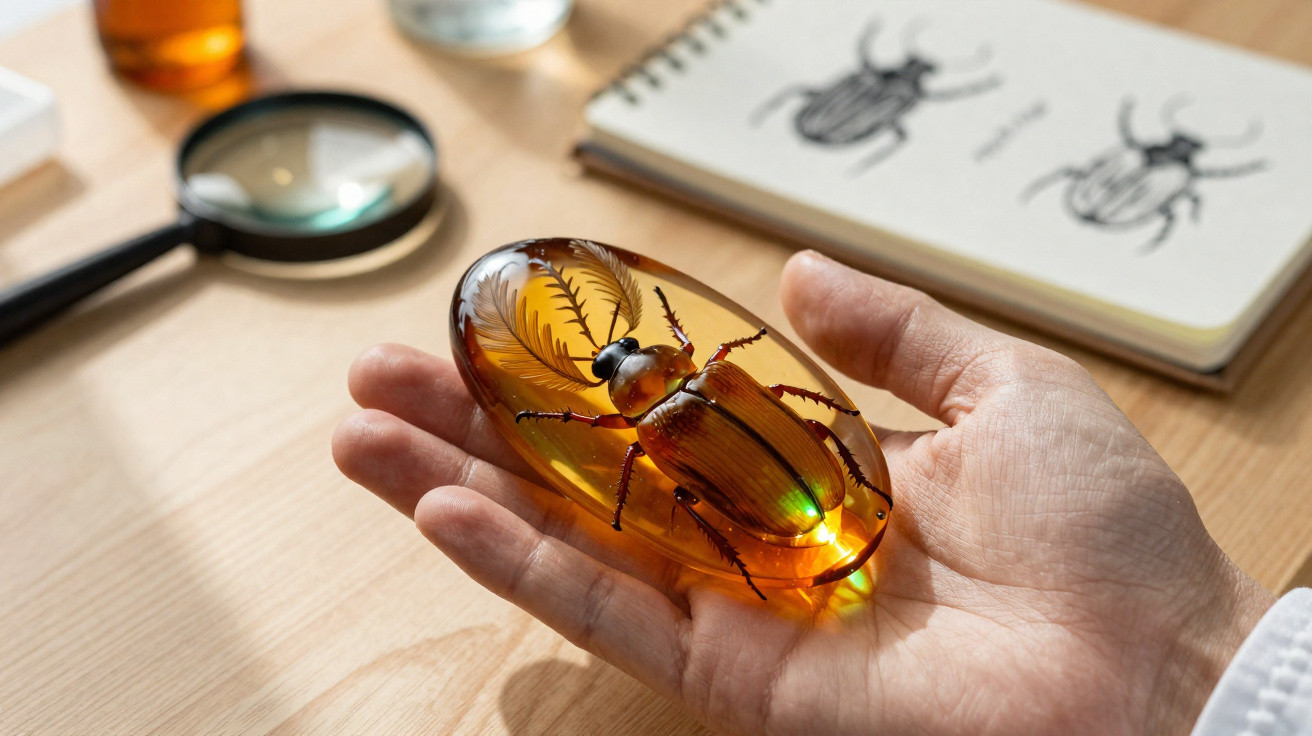
Around 100 million years ago, a small beetle was crawling over a tree in what is now northern Myanmar when it became trapped in a bead of resin.
The resin eventually hardened into amber, preserving the beetle intact within it.
When palaeontologists cut into the amber, they discovered a feature absent from every living beetle: antennae whose branches themselves divided into two distinct types.
The research was led by Yanda Li, a doctoral student at the University of Bristol, working with Professor Chenyang Cai of the Nanjing Institute of Geology and Palaeontology of the Chinese Academy of Sciences (NIGPAS).
The team named the beetle Icaroramus perisi after Icarus, the figure who flew too close to the sun. Its species name honours palaeoentomologist Dr David Peris.
Antennae unlike those of any beetle
The antennae of Icaroramus perisi each have 12 segments. Every one of the eight middle segments bears two separate pairs of side branches.
One pair emerges from the base of each segment. These branches are longer, slightly swollen at their tips and covered in coarse hairs. The other pair sits closer to the middle of the segment; its branches are shorter and thinner, with only fine hairs.
No other beetle, whether living or extinct, is known to have had antennae of this kind. The researchers describe the arrangement as quadriheteroramose: four branches of two different types on a single segment.
The additional branches probably arose from the process by which an antenna develops, forming segments in sequence before stopping.
In Icaroramus, that developmental programme appears to have restarted within segments that were already established, producing branches rather than further segments.
Branches adapted for smell
An insect’s antenna acts as its nose. Fine hairs called sensilla line the antenna and contain nerve cells that detect airborne chemicals.
Additional branches increase its surface area, providing space for more sensilla and improving the insect’s sense of smell.
Males often have the most conspicuous antennae. They must follow the faint pheromone trails left by females, and more finely developed antennae broaden their search.
Males searching by scent
The preserved specimen is male. Among many relatives of fireflies, females never develop wings.
Instead, the females retain a larval form as adults, while winged males fly away to find them.
That difference encourages males to develop better scent detectors, potentially explaining the beetle’s elaborate antennae.
Li and his colleagues interpret the branching antennae as evidence that Icaroramus perisi relied mainly on smell to find mates.
The two types of branch may have shared the work, with one detecting one class of chemical and the other responding to a second class.
A similar arrangement occurs in moths, whose main antennal shaft and branches carry different types of sensor.
A light organ for defence
The fossil also retains a light organ on the underside of its abdomen. In modern fireflies, a glow can deter predators, attract mates, lure prey or illuminate a path.
This combination makes Icaroramus unusual. Present-day fireflies rarely have both branched antennae and a functioning light, as the two features are generally associated with different mating strategies.
Species that flash to attract mates usually have simple antennae and large eyes. Those with elaborate antennae generally court by scent instead and do not use flashing for courtship.
The researchers doubt that courtship was the main purpose of the Icaroramus glow. They suggest it most likely warned predators away, a defensive function that preceded courtship flashing.
Two signals in one beetle
If the glow served chiefly as a defence, the earliest firefly relatives probably used scent for courtship. The substantial antennae of Icaroramus support that possibility.
The earliest glow may have been a feature of young beetles. In many fireflies, larvae glow to warn predators, with adults only later adopting the light for courtship.
The light organ also allows for an intermediate stage. The beetle may have started using its glow in courtship while retaining pheromones as its principal signal.
Some fireflies alive today use both channels during mating, flashing while releasing scent. Icaroramus perisi may offer a glimpse of such a dual system far back in time.
A design that vanished
No living beetle has retained these divided antennae. The researchers interpret them as a short-lived experiment, one that was either lost through selection or ruled out by later conditions.
A few living relatives develop an additional third branch on each segment, but these take the form of short, blunt bumps.
By contrast, the four branches of Icaroramus are long and fully developed, more closely resembling functional sensory tools.
The team assigns the beetle to an extinct family, Cretophengodidae, although the researchers note that its placement remains uncertain.
At approximately 1 cm long, the beetle possessed antennae unmatched by any beetle in the 100 million years since.
Image credit: YANG Dinghua















Comments
No comments yet. Be the first to comment!
Leave a Comment