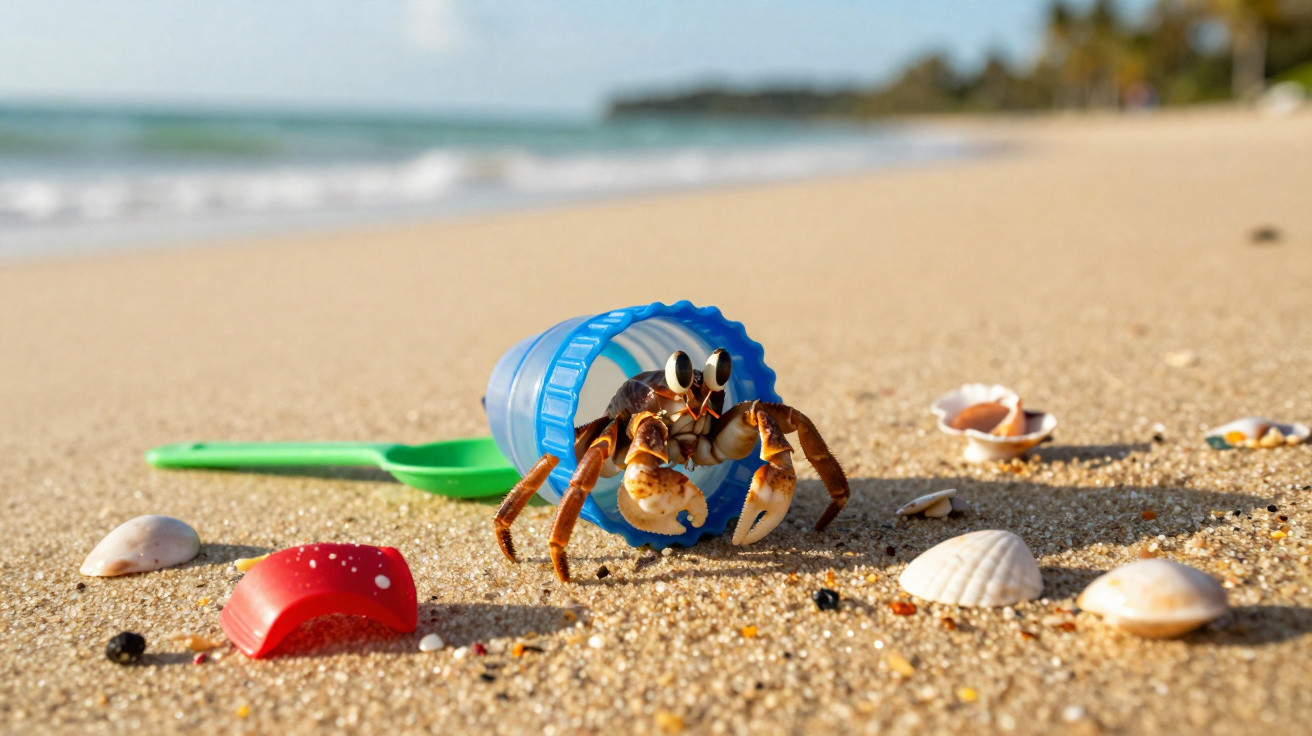
Land hermit crabs have been using bottle tops, pieces of old light bulbs and broken glass bottles in place of shells.
In a new study, Polish researchers examined 386 images of hermit crabs living in these artificial shells. Users had uploaded the photographs to online platforms, where scientists analysed them using a research method called iEcology.
In the vast majority of the 386 photographs – 326 cases – hermit crabs were using plastic objects for shelter.
At first sight, this is a striking illustration of how human activity can change the behaviour of wild animals and potentially alter how populations and ecosystems function as a result.
But many factors could be involved. Although it is easy to jump to conclusions, it is important to consider exactly what might be driving this particular change.
View this video on Facebook
Hermit crab shell selection
Hermit crabs make excellent model organisms for research because they display a wide range of behaviours, and the differences between them are easy to measure.
Unlike an ordinary crab or lobster, a hermit crab does not continuously grow its own shell to protect its body. Instead, it uses an empty shell left by a dead snail. The shell protects its soft abdomen as it walks, and the crab pulls its entire body inside whenever it feels threatened. In this way, shells serve as portable shelters.
A sufficiently good shell is essential to an individual’s survival, so hermit crabs acquire and upgrade their shells as they grow. They fight other hermit crabs for shells and assess the suitability of any new ones they find.
Their main requirement is a shell large enough to protect them, but they also consider the type of snail shell, its condition and even its colour, which could affect how conspicuous the crab is.
The availability of suitable shells is another limit on their choice. As the latest study highlights, some land hermit crabs are choosing to live in plastic objects rather than natural shells, for reasons that are not yet known.
Housing crisis or ingenious new move?
For thousands of years, humans have deliberately altered animal behaviour through domestication. Unintended changes in the behaviour of natural animal populations are potentially worrying, but how concerned should we be about hermit crabs sheltering in plastic litter?
The Polish research prompts several questions. First, how widespread is the use of plastic litter in place of shells?
Although 326 crabs using plastic may sound like a lot, it is likely to underestimate the actual number, because users are likely to encounter crabs only in accessible parts of populations.
On the other hand, users may be more inclined to upload striking or unusual pictures. The iEcology approach could therefore exaggerate the proportion of a population choosing plastic instead of natural shells. Structured field surveys are needed to establish the answer.
The second question is why some individual crabs use plastic.
They may be forced to do so by a shortage of natural shells, but that hypothesis cannot be tested without more information about the demographics of local snail populations.
Alternatively, might the crabs prefer plastic, or find it easier to locate than real shells?
As the authors note, plastic could be lighter than equivalent shells, offering the same protection at a lower energy cost to carry. Intriguingly, chemicals that leach from plastic are known to attract marine hermit crabs by mimicking the smell of food.
A third question concerns the possible disadvantages of plastic. Plastic waste is generally brighter than real shells and may stand out more against the background, potentially leaving crabs more vulnerable to predators.
We also know that exposure to microplastics and compounds leaching from plastic can alter hermit crab behaviour. It can make them less selective about their shells, less capable of fighting for them and even change their personalities by making them more inclined to take risks. To understand the causes and consequences of hermit crabs using plastic waste in this way, we need a series of laboratory experiments examining their shell selection behaviour.
Pollution changes behaviour
Plastic pollution is only one way in which we are changing our environment. It is by far the most widely reported form of debris that humans have introduced into marine environments. Other forms of pollution affect animal behaviour too, including microplastics, pharmaceuticals, light and noise, as do the rising temperatures and ocean acidification caused by climate change.
Investigating hermit crabs’ use of plastic waste could therefore improve our understanding of the consequences of certain human impacts on the environment. It does not, however, show exactly how animals will adjust to the Anthropocene, the era in which human activity has had a significant impact on the planet. Will they cope through plastic behavioural responses, evolve across generations, or perhaps do both?
In my view, the iEcology approach cannot answer such questions. Instead, this study serves as an alarm bell, drawing attention to potential changes that now require full investigation.
Mark Briffa, Professor of Animal Behaviour, University of Plymouth
This article is republished from The Conversation under a Creative Commons licence. Read the original article.




Comments
No comments yet. Be the first to comment!
Leave a Comment