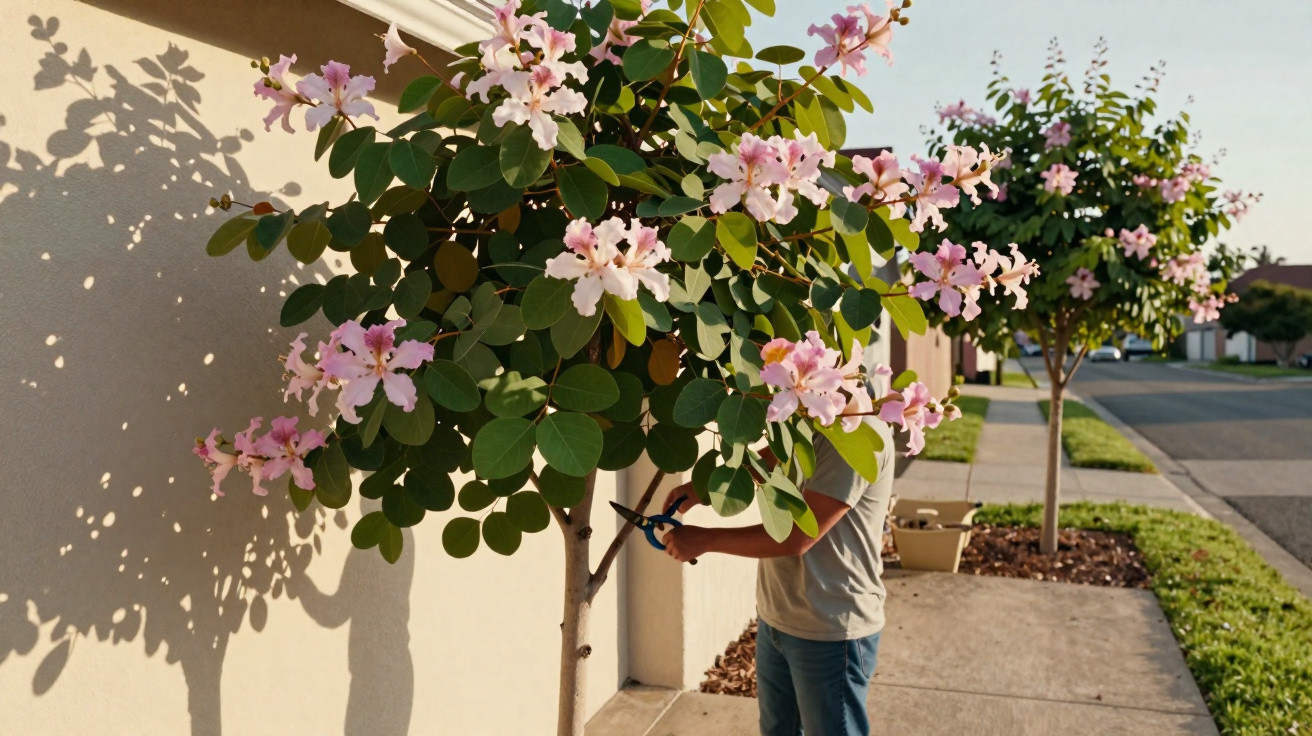
The pata-de-vaca (a name used for several species within the genus Bauhinia) has a mix of traits that suit front gardens and pavements: a medium-sized habit, fairly quick growth, a rounded canopy, and roots that are often not especially aggressive. Its pink, lilac or white flowers also add ornamental appeal and draw in pollinators during the flowering season.
Why does pata-de-vaca work well near homes?
Some Bauhinia species form shallow root systems that are regarded as relatively non-aggressive and, for that reason, they are used in street planting. This lowers the chance of damage when compared with trees whose roots spread very widely, but it does not mean they can be planted right up against paving, foundations or pipework.
Bauhinia includes hundreds of species, and among them are ornamental trees commonly called pata-de-vaca. Because mature size, flowering and root behaviour differ from one species to another, confirming the species before planting helps you avoid choosing a tree that will outgrow the space you have.
- A suitable size for many residential gardens;
- A rounded canopy that can provide shade;
- Relatively fast growth in good conditions;
- Good adaptation to tropical and subtropical climates;
- Less aggressive roots in many species used for landscaping.
Do the flowers really appear for almost the whole year?
Flowering length depends heavily on the species and on local climate. Bauhinia variegata, for instance, typically concentrates its blooms between winter and spring, while other types follow different cycles. In warmer regions, the ornamental display can last longer, but it is not accurate to promise flowers in virtually every month for any pata-de-vaca.
How should you plant to avoid problems with paving and walls?
Even a tree with less aggressive roots needs a permeable area around the trunk and enough room for the trunk to thicken over time. Before digging the planting hole, it is sensible to identify any buried pipes, check the distance to the building, and think about how wide the canopy will be when the tree is fully grown.
Where space is tight, leaving a few metres between the tree and walls or other key structures provides a better margin for healthy development. The same kind of planning applies when selecting shade trees for compact gardens, where root behaviour is only one of several planting criteria.
- Choose a spot that gets several hours of direct sun;
- Keep clear space around the trunk;
- Avoid planting directly above water and sewer lines;
- Water regularly while the young tree is establishing roots;
- Opt for well-drained soil enriched with organic matter;
- Consider the canopy’s future spread before deciding on the final position.
Why are formative (training) prunings important?
A young Bauhinia can benefit from formative pruning to create a well-structured main trunk and to keep branches clear of roofs, walkways and vehicles. Once the canopy is established, pruning should focus on removing dead, broken, crossing or poorly placed branches, while avoiding heavy cuts that weaken the tree and reduce flowering.
Does the leaf shape explain the name pata-de-vaca?
The bilobed leaves have a central split that resembles a bovine hoof, which explains the names pata-de-vaca, cow’s hoof, and similar references. Some species-especially Bauhinia forficata-also appear in traditional medicine, but medicinal use should not be based solely on visual identification, since different Bauhinia can be mistaken for one another and plant-based preparations also carry risks.
As an ornamental tree, the pata-de-vaca combines a pleasing canopy, relatively quick growth and striking flowers, without-among several commonly grown species-having a root system known for high aggressiveness. With appropriate clearance from buildings, a permeable planting area, and well-planned formative pruning, it can be used in gardens and along pavements without relying on intensive maintenance to keep its shade and flowering.










Comments
No comments yet. Be the first to comment!
Leave a Comment