In a nearly unreachable corner of the North Pacific, a scientific expedition has descended beyond familiar abysses and found something alive.
What was expected to be another technical dive to the floor of the Kuril Trench became a major scientific surprise: confirmation of a vast ecosystem roughly 10 kilometres beneath the sea surface, in conditions that until recently were regarded as almost incompatible with life.
An abyss untouched by light
Below 6,000 metres, oceanographers refer to the “hadal zone”. This is the domain of ocean trenches, defined by total darkness, temperatures close to 0 °C and pressure that can exceed 1,000 times atmospheric pressure at sea level. For decades, marine-biology textbooks portrayed this extreme realm as an almost lifeless desert, inhabited only by scattered and poorly diverse forms of life.
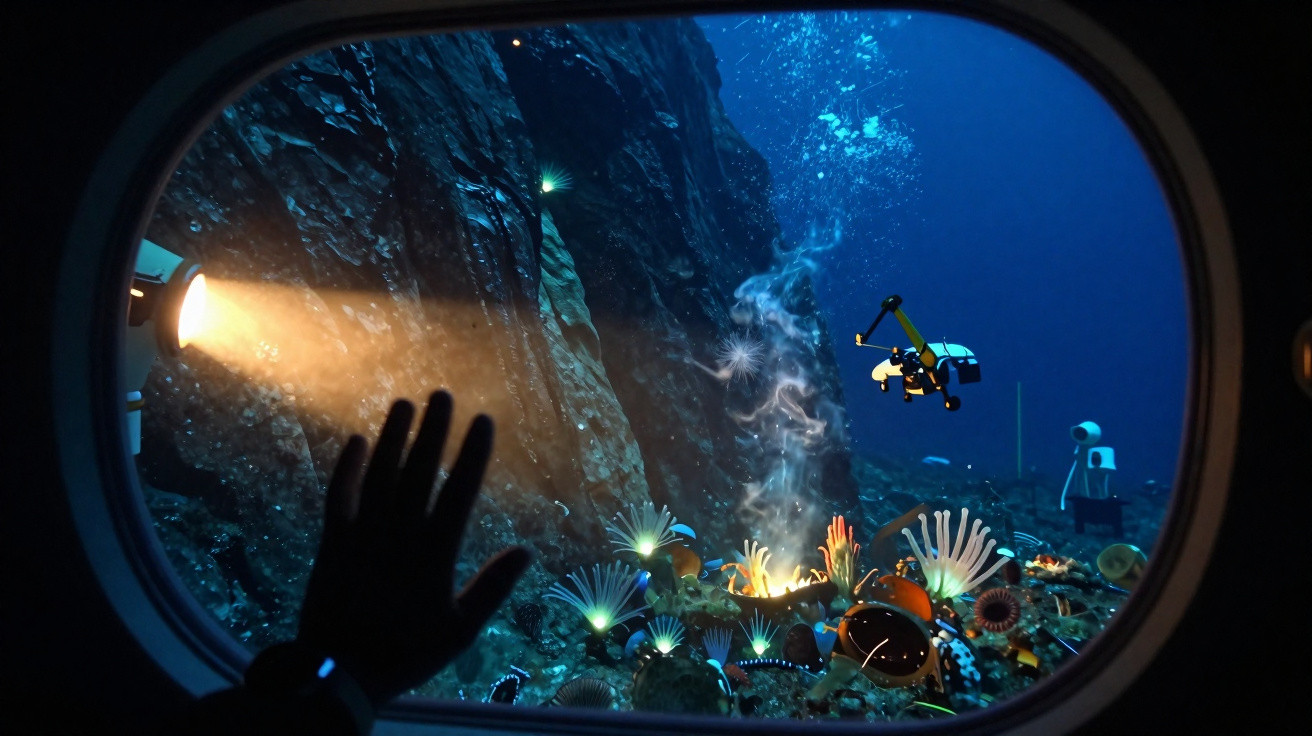
Images and samples gathered in 2024 by a team aboard the research vessel Tan Suo Yi Hao challenge that assumption. Using the crewed submersible Fendouzhe, the scientists descended near the Kuril Trench, between Japan and the Kamchatka Peninsula, recording something no one expected to see below 9,500 metres: a genuine “forest” of life rising from dark, seemingly sterile sediments.
At the boundary between rock and mud, dense colonies of tube worms, crustaceans, bivalves and other organisms emerge, forming a living mosaic where biological silence had previously been imagined.
The researchers describe extensive groups of worms extending from the seabed like white and reddish straws, creating formations resembling clumps of vegetation. Small crustaceans, agile amphipods, elongated sea cucumbers and sturdy molluscs move among them, all adapted to pressures capable of crushing most human-made machinery.
The geological scar sheltering a hidden world
The Kuril Trench is an elongated fracture in the ocean floor created as the Pacific Plate subducts beneath the Okhotsk Plate. On bathymetric maps, it appears as a deep incision, with sections approaching or exceeding 10,000 metres. Far from being a quiet valley, this structure contains active faults, micro-earthquakes and substantial movement of underground fluids.
These fluids carry methane, hydrogen sulphide and other compounds, seeping gently through areas known as “cold seeps”. They are not spectacular geysers like some hydrothermal vents, but continuous leaks that are almost invisible to an ordinary camera. It is precisely here that the newly described ecosystem has its core.
Where sunlight cannot reach, chemistry takes on the role of the primary energy source, supporting entire food chains without a single leaf or grain of photosynthetic plankton.
Life sustained by seafloor chemistry
At these seep sites, specialised bacteria and archaea use reactions involving methane, sulphur and carbon dioxide to make organic matter. This process is called chemotrophy. Rather than turning light into sugars as plants do, these microorganisms convert chemical energy into biomass.
- Chemotrophic bacteria: the foundation of the food chain, converting inorganic compounds into organic matter.
- Siboglinid worms: tube-dwelling animals with no complete digestive system, which host symbiotic bacteria within their tissues.
- Bivalves and crustaceans: filter carbon-rich particles or feed on material that has accumulated in the sediment.
- Sea cucumbers and other detritivores: recycle the remaining material, keeping the nutrient cycle active.
This biological mechanism operates in a delicate balance with the geology. When methane flow declines, organic-matter production contracts. If faults open or close, colonies may move or vanish. To the researchers, the Kuril Trench contains a mosaic of chemical “energy islands” scattered across the seabed, linked by currents, sediments and the migration of organisms.
The limits of life shifted once again
Confirmation of a structured ecosystem at almost 10 km deep challenges fundamental ideas about where life can establish itself. Over recent decades, hydrothermal vents, underground lakes and porous rocks kilometres beneath the surface have already broadened that map. Ocean trenches now become more than dark holes on nautical charts: they are natural laboratories for studying extreme biology.
For many astrobiologists, environments of this kind offer a direct parallel with worlds beyond Earth. Internal oceans within moons such as Jupiter’s Europa or Saturn’s Enceladus may contain similar ingredients: liquid water beneath thick layers of ice, heat sources generated by friction between plates, dissolved salts and chemical reactions capable of producing energy.
| Environment | Energy source | Possible extraterrestrial analogy |
|---|---|---|
| Hadal zone in the Kuril Trench | Chemotrophy based on methane and sulphur | Subsurface oceans of icy moons |
| Shallow hydrothermal vents | Reactions between seawater and magma | Active crusts on rocky planets |
| Deep aquifers in Earth’s crust | Reactions involving radioactive minerals | The interior of Mars |
If microorganisms can turn toxic gases into food 10,000 metres below the surface, it becomes easier to envisage life forms adapted to places that will never receive a ray of sunlight. The discovery in the Kuril Trench does not by itself answer the question of life beyond Earth, but it provides a concrete model of how entire food chains can persist far from the surface.
Human pressure in an environment we barely understand
As science works to understand this puzzle, commercial interest in the ocean floor is increasing. Rare metals used in batteries, specialist alloys and advanced technologies accumulate in polymetallic nodules and cobalt-rich crusts across similar abyssal regions. Companies and governments are discussing rules for deep-sea mining, often with limited evidence of its real impacts.
The identification of complex communities in such an extreme region raises a warning. Mechanical disruption caused by machinery, plumes of remobilised sediment and changes to fluid circulation could smother microorganisms, bury worm colonies and break symbiotic relationships that took millions of years to develop.
With every new camera sent down to these depths comes the sense that we know less than we thought about an environment that some are already preparing to exploit commercially.
Concepts that help explain the abyss
Two terms appear frequently in studies of this kind of ecosystem and help clarify the discovery:
- Hadal zone: the oceanic band generally extending from 6,000 to around 11,000 metres deep, associated with tectonic trenches. It is characterised by high pressure, low temperatures and the complete absence of sunlight.
- Cold seep: an area of the seafloor where methane- and sulphide-rich fluids escape continuously, without major temperature differences from the surrounding water. These sites support communities dependent on chemotrophy.
It helps to picture the setting as a chain of small chemical clearings dispersed along thousands of kilometres of seafloor. Each clearing contains dense colonies of organisms, like oases separated by stretches of apparently empty sediment. Deep currents, suspended particles and slow migrations connect these living islands, allowing genetic exchange and the movement of nutrients.
In simulations conducted by ecological-modelling groups, disruption at only some of these sites has already produced cascading effects along the entire line of seeps. A reduction in methane flow in one section, for instance, can weaken the microbial base and, over time, reduce worm density and limit the presence of larger predators. This points to a system that is resilient, but not invulnerable.
Researchers suggest that future missions should combine direct observations with laboratory experiments replicating the pressure, temperature and chemical composition of the Kuril Trench. Such work could reveal new compounds, pressure-adapted enzymes and as-yet-unknown biochemical strategies. These findings matter beyond ecology: fields including pharmacology, biotechnology and even materials engineering are closely monitoring what emerges from these discreet abysses.










Comments
No comments yet. Be the first to comment!
Leave a Comment