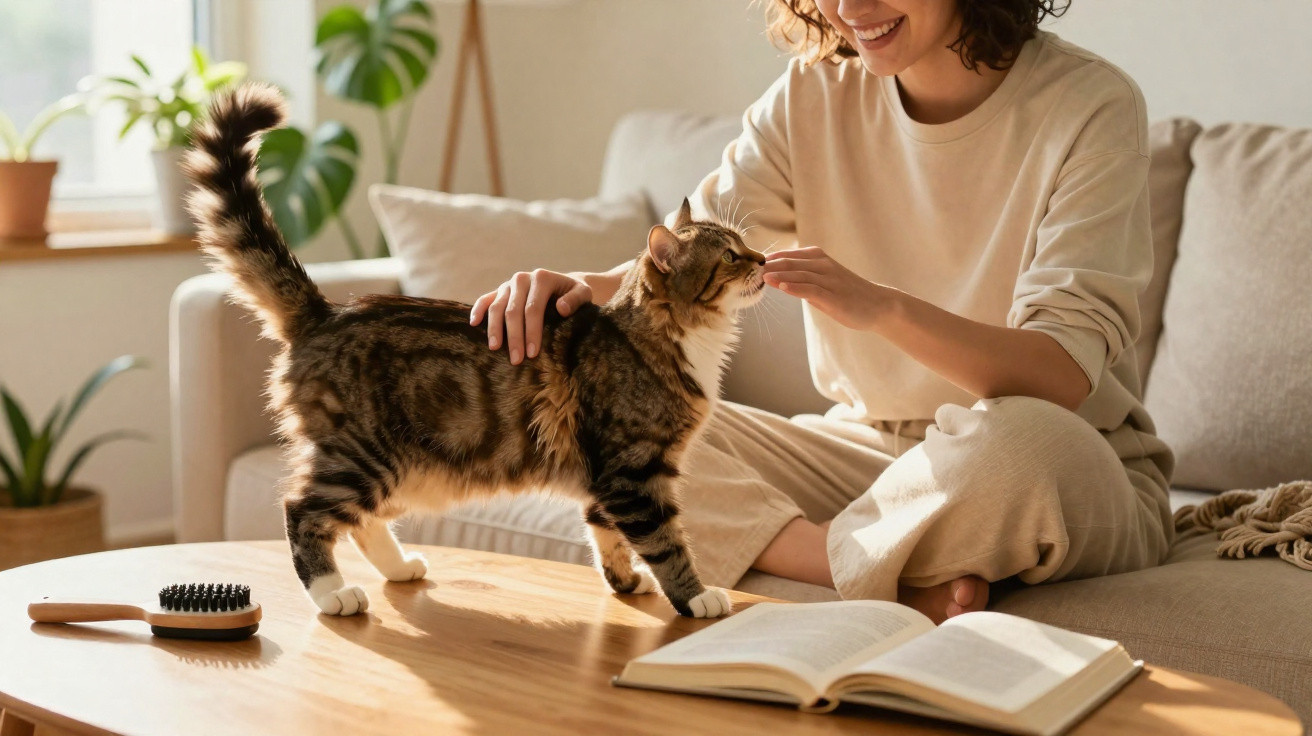
You are half asleep on the sofa when it happens again: a small, scratchy sweep across your hand, followed by another that is more determined. Your cat is curled up beside you, eyes partly shut, carefully licking your fingers as though you were an exceptionally poorly washed spoon. It tickles, can occasionally sting a little, and you start to wonder quietly whether you are being groomed, claimed… or assessed.
The room is still, apart from the soft rasp of that sandpaper-like tongue.
Some cats are delicate about it; others commit completely, working over your arm, face or even hair with unwavering purpose. You sometimes draw away, only to feel strangely guilty, as if you had turned down a hug.
What could possibly be happening inside those furry little minds?
This strange habit that actually makes sense to your cat
Anyone who has seen a mother cat with a litter of kittens will know that licking begins almost immediately. She grooms them to keep them clean, reassure them and rouse them to feed. For cats, the tongue is more than an eating tool: it is a form of communication. So, when your grown cat picks your hand or face for this treatment, they are not simply acting oddly. They are relying on the tool they trust most: grooming.
For us, it can feel rather like a brief exfoliating treatment.
For them, it is more like a love letter composed of tiny, scratchy strokes.
Imagine the scene: you are working late at your laptop, with tense shoulders and eyes worn out by the screen. Your cat leaps onto the desk with the effortless arrogance only cats possess, strides over the keyboard and settles on your forearm. Then the licking begins: slow and deliberate, exactly where your pulse is beating.
You exhale, partly irritated and partly moved.
Researchers studying cat-human relationships describe “allogrooming” – social grooming between individuals who trust each other. Cats that groom one another are generally the closest members of a group. When your cat licks you, they are placing you within that inner circle.
From your cat’s perspective, your skin carries your own scent, naturally, along with traces of everything else from your day: food, outdoors, other people and perhaps other animals. The licking is partly about tidying you up and partly about covering you with their own scent. That rough tongue leaves tiny secretions from their mouth on your skin.
This is their way of saying: “You belong to my group. You smell like us now.”
The action also has a self-soothing element. Grooming releases feel-good hormones in cats, acting as a built-in way to manage stress. So, if they are licking you obsessively, they may be soothing you… while calming themselves too.
How to respond when your cat won’t stop licking you
A simple detail can make a significant difference: your reaction in those first few seconds. If you sharply pull your hand away every time, your cat may interpret it as play. They lick, you move, and they make another attempt. Instead, respond slowly and calmly. Allow one or two licks, then use your fingers to gently guide their head towards a toy or their own fur.
You could also provide another option by offering a small soft toy or your sleeve.
Some cats will readily switch their licking to this new “target” and still complete their little ritual.
Many people quietly put up with painful grooming because they do not want to upset their cat. The tongue repeatedly rubs the same area, making it red or sore, yet we remain there and act as though nothing is wrong. This is when irritation can build.
You can draw a boundary without damaging your relationship.
Brief, reliable cues are useful: say a quiet “no”, gently move your hand, then offer a cuddle or stroke them elsewhere. Avoid forcefully shoving them away or raising your voice, particularly when the licking is clearly affectionate. They are not “being naughty”; they are simply following the only social language they learnt as kittens.
“When cats lick their owners, they’re often mixing affection, habit and a bit of territorial behavior,” explains one feline behaviorist. “The key is not to punish the instinct, but to channel it into something both sides can live with.”
- Redirect instead of rejecting
After a few licks, offer a toy, blanket or your cat’s own fur as a different focus. - Watch for sudden changes
When a cat that is normally uninterested suddenly begins compulsive licking overnight, it may indicate stress, pain or illness. - Protect your skin
If their tongue feels like sandpaper on sunburnt skin, calmly move away and engage differently through play, brushing or gentle conversation. Honestly, nobody manages this every single day.
When a lick is love… and when it’s something else
When you begin to observe closely, you may find that your cat does not lick you at random. They often select peaceful moments, familiar areas of your body and a particular pace. Some only groom you after you return from work. Others do it when you are unhappy or unwell, staying nearby and repeatedly licking one spot with an almost nurse-like focus.
There is a pattern to it, even if it first appears chaotic.
We have all had that moment when their rough tongue touches your cheek precisely when you needed some sign of comfort, and somehow it helps.
| Key point | Detail | Value for the reader |
|---|---|---|
| Affection and bonding | Cats use licking as social grooming to mark you as part of their inner circle | Helps you understand your cat’s signals as affection rather than random odd behaviour |
| Stress and self-soothing | Repetitive licking can calm the cat and sometimes reflects anxiety | Offers clues about when to comfort them, play more or seek advice from a vet or behaviourist |
| Setting gentle limits | Redirection, short sessions, and alternative rituals reduce painful licking | Allows you to protect your skin while maintaining a close bond with your cat |














Comments
No comments yet. Be the first to comment!
Leave a Comment