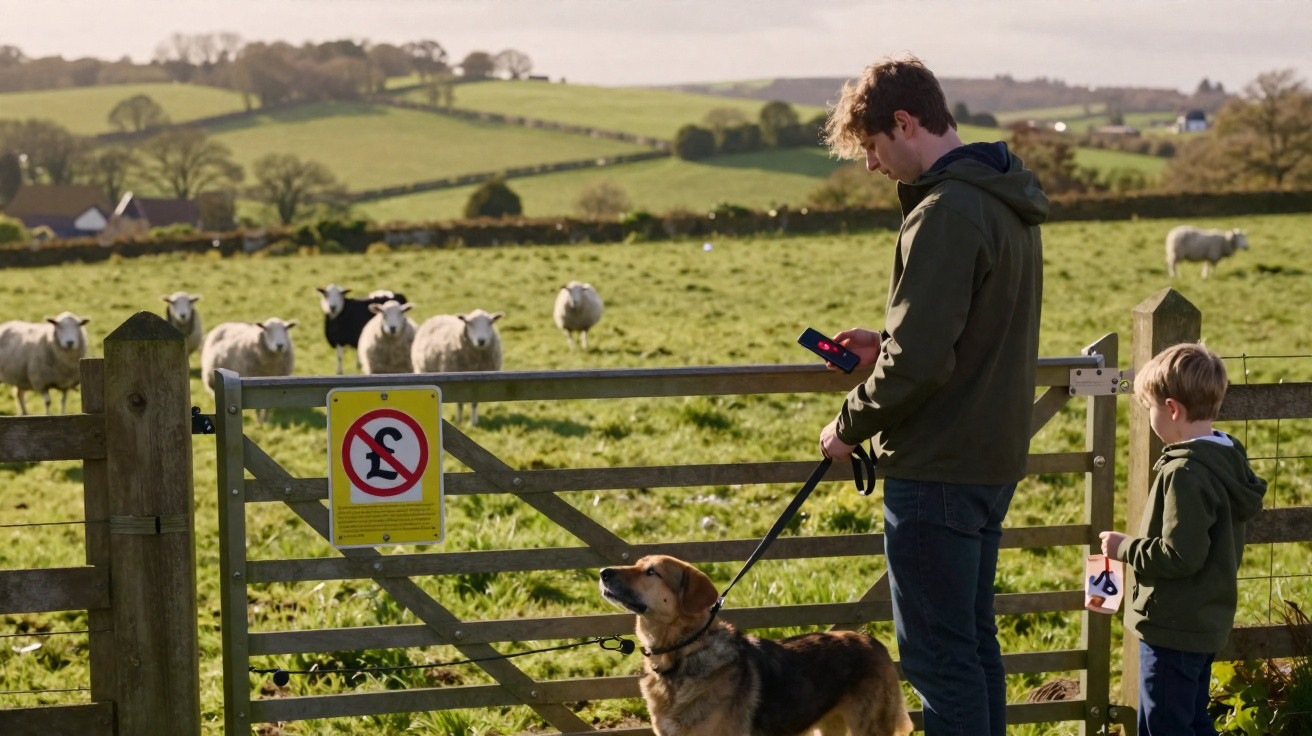
From this week, significantly stricter rules apply to dog owners walking in England and Wales – particularly in the countryside.
Anyone who enjoys taking their dog across meadows, along farm tracks or on coastal paths in England or Wales must now prepare for a far tougher approach. New legislation changes several key rules, making offences involving dogs near grazing animals more costly and troublesome than ever.
What is fundamentally changing for dog walks
Since Wednesday 18 March 2026, the Dogs (Protection of Livestock) (Amendment) Act 2025 has applied in England and Wales. With it, the Labour government is updating legislation from the 1950s, when there were far fewer dogs, cars and leisure visitors in the countryside.
The central point: any dog that chases or disturbs livestock can place its owner in serious legal difficulty – even where no biting occurs.
The requirements mainly affect countryside walks, but also paths and roads running alongside fields. It is not only the breadth of the rules that is new: the potential penalties have also become much more severe. The previous upper limit on fines has been removed entirely.
Chasing alone is enough: when a dog “worries livestock”
One aspect has left many owners puzzled: a dog does not even have to touch a sheep, cow or goat. Chasing an animal, running into a flock or startling it can be sufficient.
The government puts it this way: a dog does not need to make physical contact to breach the law. Chasing or disturbing livestock may itself cause harm, including stress, injuries suffered while fleeing, or miscarriages in pregnant animals.
The key question, therefore, is not whether an animal is bitten, but whether the dog “worries” livestock. Typical examples include:
- A dog races towards a flock of sheep “just to play”
- A dog repeatedly barks alongside a pasture and agitates the animals
- A dog runs through a fenced field as animals panic and move away
- A dog crosses a pasture to reach a stream or path on the other side
Such incidents may seem harmless to an owner, but they can have serious consequences for sheep or pregnant cattle. This is precisely where the new law intervenes: the threshold between “nothing happened” and a criminal offence is now considerably lower.
Wider scope: paths, roads and less familiar livestock species
The rules cover more places than many people realise. The amendments no longer apply solely to conventional arable land and pastures.
They now also include:
- Tracks and footpaths immediately beside fields
- Country roads alongside grazing land
- Farms and sites keeping camelids, including llamas and alpacas
- Mixed farms with less common livestock breeds
Anyone who walks past an alpaca farm on a favourite weekend route or plans a stroll alongside cattle pastures therefore falls fully within the scope of the legislation.
Unlimited fines: what dog owners now risk
Previously, the maximum fine was £1,000. That cap has now been abolished without replacement. A court can impose a penalty based on the seriousness of the incident and the owner’s financial circumstances, with no upper limit.
In theory, the fine can run into tens of thousands if substantial damage is caused to a flock or the owner acted particularly recklessly.
Other possible consequences include:
- Being required to cover the cost of catching and housing the dog
- Paying veterinary bills or losses involving pregnant animals
- Orders restricting how the dog may be kept
- Criminal penalties in especially serious cases
The police also have extensive new powers. Under certain conditions, officers may enter premises, seize dogs and secure samples to prevent repeat incidents. For owners, this means that ignoring warnings can quickly result in a visit from the authorities.
What the new law means for family walks
Despite the strict tone, the government and authorities stress that they do not want to drive families out of the countryside. Walks with children and dogs remain expressly welcome, provided they are carried out responsibly.
The clear message is that the countryside should remain accessible, but grazing animals take priority over a four-legged urge for freedom.
In everyday terms, this means:
- Put the dog on a lead in good time as soon as livestock comes into view
- Explain early to children that “just chasing after them once” is not a good idea
- Stay on paths rather than cutting across fields containing animals
- Take warning signs from farmers and local authorities seriously
There is also a new protection for responsible owners where a dog has come into someone else’s hands without consent. If, for example, the animal was stolen or another person takes it for a walk without permission, the owner is not automatically liable for the incident. This is intended to protect people from having to fear consequences for situations beyond their control.
Why the United Kingdom takes the issue so seriously
The tougher approach has a real background. Rural areas have seen mounting reports for years of sheep being killed, calves injured and stress-related miscarriages after dog attacks or chasing incidents. For smaller farms, losing several animals can threaten their livelihood.
At the same time, dog ownership and recreational trips into the countryside are increasing. Many people newly living in rural areas know little about how farming operates. This creates a conflict the government aims to ease through clear rules: anyone using the countryside shares responsibility for the animals that live there and support many families’ livelihoods.
Lessons for dog owners in Germany, Austria and Switzerland
The new requirements apply only in England and Wales. Nevertheless, they offer owners in German-speaking countries a clear indication of what is tolerated on meadows and fields – and what is not. Dog owners there are already liable for damage caused by their animals, while some federal states have similar requirements, such as compulsory leads during the breeding and nesting season.
Anyone holidaying in Great Britain with a dog should check local rules in advance. On well-known long-distance trails or coastal stretches with sheep pastures in particular, breaches can quickly become very expensive. A sturdy, suitably long dog lead and a well-fitting harness should therefore be packed.
Practical tips: keeping dogs calm around livestock
Rules alone are rarely enough. Owners who want to prepare their dog more effectively can achieve a great deal with simple training steps:
- Strengthen recall: Practise every day, initially without distractions and later near animals – always with the dog on a lead.
- Reward calmness: If the dog looks briefly at sheep and then turns its attention back to the owner, give it a treat.
- Keep your distance: It is better to walk a few metres farther from the fence than pass directly beside the flock.
- Build alternative behaviour: For example, teach the dog to walk to heel whenever livestock appears.
Anyone who feels unsure can attend a dog-training school specialising in everyday rural situations. Trainers often recreate exactly the situations that later become critical during walks.
Key terms explained: “livestock”, camelids and more
In the legislation, the term “livestock” refers to farmed and grazing animals used in agricultural production. Familiar examples include sheep, cattle, goats and pigs. Newly included are camelids: llamas, alpacas and similar species, which are increasingly kept on smaller farms or as visitor attractions.
In practical terms, the precise species makes no difference for dogs. The important point is this: if a dog is near farm animals, it should be on a lead. That reduces stress for both animals and owners – and, in England and Wales, the risk of a hefty fine.












Comments
No comments yet. Be the first to comment!
Leave a Comment