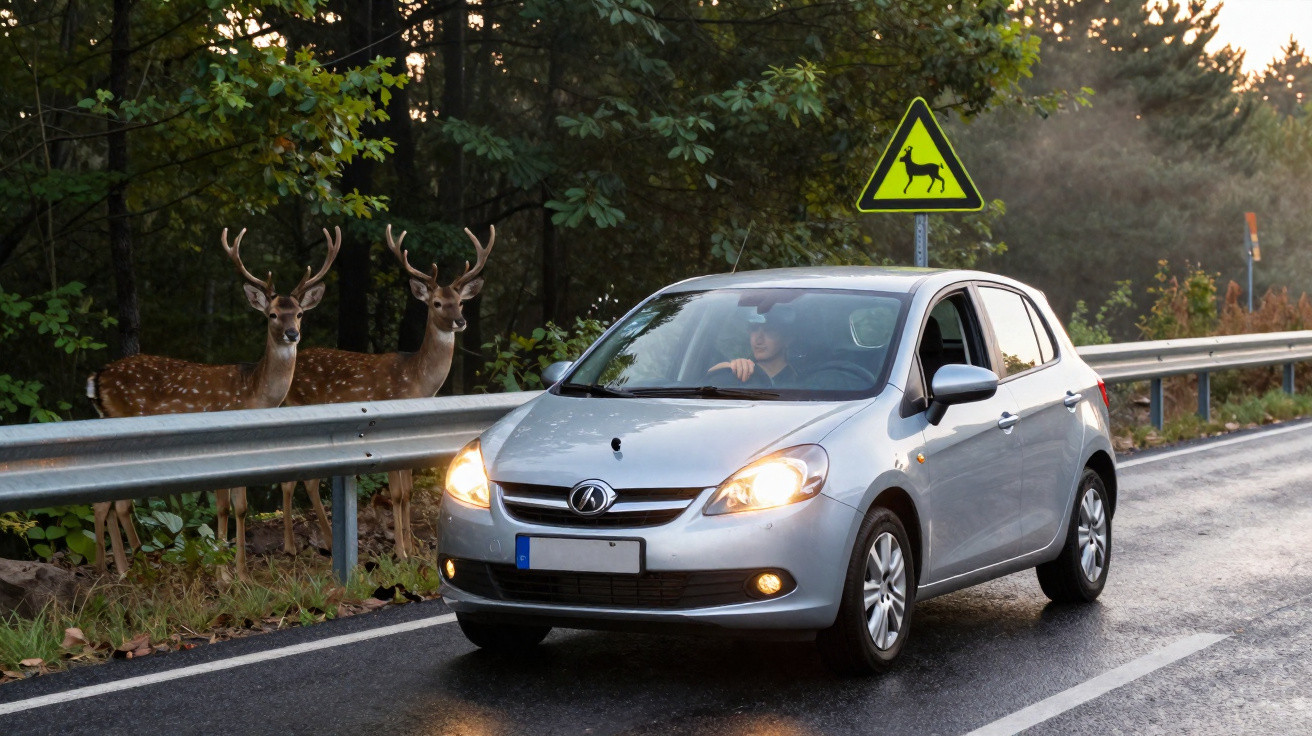
Driving on rural roads at dusk often brings an uneasy feeling: a deer or stag could be standing just beyond any bend. So-called wildlife warning devices, or deer whistles, are sold as a cheap way to keep animals away from the road using ultrasound. Yet what appears to be a clever solution proves, on closer inspection, to offer a false sense of security.
How deer whistles are supposed to work
Most versions are made up of two small plastic units attached to the front of a car, usually with a simple adhesive pad. Once the vehicle reaches a certain speed, air flows through their openings and is meant to create high-pitched sounds. Manufacturers claim these frequencies can be heard by wildlife but not by people.
The advertising claims are appealing: an “acoustic safety zone” is supposedly created in front of the vehicle. Wildlife hears the sound, becomes wary and does not enter the carriageway. Some sellers even claim a range of several hundred metres, referring to alleged experience in North America or Australia.
Some products use two separate whistles: one producing a constant note and another with a changing pitch. This is intended to prevent animals becoming accustomed to the sound. To many drivers, the idea sounds technically convincing, particularly as the devices cost only a few pounds and can be fitted within seconds.
Cheap, simple and accompanied by sweeping promises: that combination is precisely why deer whistles sell so well. However, the evidence clearly argues against them.
What research actually says about deer whistles
Transport researchers and wildlife biologists have examined the effectiveness of these devices in several studies. Their work has included both laboratory tests and analyses of collision statistics. The conclusion is sobering: no measurable safety benefit can be demonstrated.
In controlled tests, deer and roe deer were deliberately exposed to the frequencies that the whistles are theoretically expected to generate. Researchers closely recorded the animals’ behaviour, including where they looked, how they moved and whether they attempted to flee. Their responses differed little from those of animals that heard no sound.
Evidence from field trials involving large vehicle fleets is particularly informative. These compared collision figures for cars fitted with wildlife warning devices against vehicles without this additional equipment.
| Measure | Vehicles with deer whistles | Vehicles without deer whistles |
|---|---|---|
| Wildlife collisions per 100,000 km | 3,2 | 3,1 |
| Visible response from wildlife at the roadside | 12 % | 11 % |
| Effective distance of the warning signal | under 3 metres | – |
The differences fall within statistical noise. Put simply, drivers using deer whistles are not measurably safer than those without them.
Acoustic limits: why the sound barely reaches animals
Acoustic specialists identify several fundamental flaws in the concept. Firstly, the whistles are extremely quiet. Their energy comes solely from airflow around the moving vehicle: there is no amplifier, motor or electronics. Even a modern car’s engine noise is considerably louder than the sound they produce.
In addition, high frequencies are absorbed by the air far more strongly than low frequencies. They travel less effectively around obstacles and quickly lose intensity. Bushes, ditches, embankments and even damp air, especially at dusk, absorb much of the sound energy.
- Wind and tyre noise mask the whistle’s sound.
- High-frequency sound is heavily damped in open countryside.
- The noise generally remains very close to the vehicle.
- Animals are more likely to notice the engine and headlights than a quiet whistle.
Measurements show that only a few metres in front of the car, the sound level has already dropped enough to disappear into natural background noise. Even if a roe deer could theoretically hear it, in real conditions it is too weak to trigger a reliable reaction.
Biology rather than marketing claims: how roe deer and stags really respond
Manufacturers assume that wildlife will panic in response to any unfamiliar noise. Wildlife biologists disagree. Roe deer and stags often live near roads, railway lines and settlements. Every day they hear engines, tractors, chainsaws and human voices. Their brains constantly filter these sounds: which signals indicate danger and which do not?
Animals quickly adapt to persistent noises. Even if deer whistles were initially unsettling, the response would diminish after a short period. Observations on roads regularly used by vehicles fitted with such devices demonstrate this: wildlife notices the vehicles but does not respond differently from the way it does to cars without whistles.
Wildlife does not react to “theory”, but to immediate danger: speed, proximity, light and movement.
Behaviour is also unpredictable. A roe deer that freezes may, in the best case, remain at the roadside. At the worst possible moment, however, it may still leap forward at the last second - directly in front of the vehicle. A consistent “startle effect” is therefore wishful thinking rather than a safety measure.
What genuinely helps: strategies for avoiding wildlife collisions
Reduce speed – the most effective measure
The most important protection against wildlife collisions is straightforward: drive more slowly. Reducing speed by just 20 km/h can substantially shorten braking distance and greatly reduce impact energy.
Road safety experts advise particular caution at known wildlife crossing points and after stretches of woodland. On roads carrying warning signs, speed should be noticeably reduced, especially at dusk and at night.
Better visibility and earlier reactions
When driving in darkness, use full beam wherever it will not dazzle others. The reflective eyes of roe deer and stags can then be spotted much sooner. It is important to lift off the accelerator as soon as even the faintest reflection appears at the roadside.
If an animal becomes visible:
- reduce speed immediately;
- apply emergency braking if necessary;
- do not swerve uncontrollably, especially into oncoming traffic.
Other animals are often nearby. Anyone who sees a single roe deer should expect others to follow, particularly in autumn when the animals move around more.
Know the seasons and times of day
Wild animals are especially active during two periods: at dusk and during the autumn mating season. Reports of wildlife collisions increase during these weeks. Anyone commuting early in the morning or late in the evening every day faces a distinctly higher risk.
Journeys that can be planned may sometimes be moved to another time. Where that is not possible, greater attentiveness is the only answer: look well ahead, scan the surroundings and keep your fingers on the indicator stalk rather than the radio.
Vehicle technology: more than a gimmick
While airflow whistles are largely symbolic, modern driver-assistance systems can provide genuine protection. High-specification vehicles have emergency braking assistance with camera or infrared support. Some systems can also detect wildlife at the roadside and alert the driver with visual or audible warnings.
These systems are not perfect, but they can provide crucial milliseconds when animals suddenly leap into the road. Combined with prompt braking by the driver, they significantly reduce the risk of injury.
What deer whistles can still cause
The greatest problem is not the small plastic housings themselves, but what they do to the driver’s mindset. Anyone who believes they are “protected” by a five-pound stick-on device may unconsciously accept more risk. This psychological effect is well known in safety research.
Some motorists reassure themselves with the thought: “I have the whistles fitted, so nothing will happen to me.” That very confidence can lead to lower speeds of caution and care. Objectively, it is more likely to create a disadvantage than a benefit.
The illusion of safety is often more dangerous in road traffic than taking no additional measure at all.
There is another issue: incorrectly fitted wildlife warning devices may whistle, rattle or come loose. In extreme cases, they can end up on the carriageway and become debris for following vehicles. Technically, they are simply unnecessary attachments with no proven benefit.
Practical advice for drivers in wildlife areas
Anyone who regularly drives through wooded or rural areas can reduce their risk by following a few simple rules:
- Take wildlife crossing signs seriously and adjust your speed.
- Do not fix your gaze solely on the centre of the road; also watch the verges.
- Increase the gap to the vehicle ahead in high-risk areas.
- Brake rather than swerve - a tree at the roadside is often more dangerous than a roe deer.
- After a wildlife collision, contact the police, do not touch the animal and do not begin an unauthorised search.
Younger drivers in particular, who have not often encountered wildlife behaviour on the road, can benefit from experienced commuters’ accounts or from road-safety training focused on rural driving. Many road safety organisations and insurers offer suitable courses.
Why the deer whistle myth persists
The idea of controlling nature with a small trick is tempting. Anecdotes add to its appeal: a neighbour insists that they have not had a wildlife collision since fitting the devices. What is easily overlooked is that most drivers never have such a collision throughout their lives, with or without a whistle.
People tend to turn chance connections into cause-and-effect chains. Someone who drives for years without an accident after fitting a wildlife warning device is likely to credit the plastic item rather than their luck, driving style or simply the low density of wildlife on their route.
The dispassionate view of the data presents a different picture: no significantly lower collision figures, no clear changes in wildlife behaviour and major physical limits on the signal. Little therefore remains of the manufacturers’ sweeping promises.
Anyone who still wishes to decorate their car with deer whistles may do so; in most cases, they cause no harm. Real safety ultimately comes from something that cannot be bought in a packet: an appropriate speed, alert senses and respect for one of the most unpredictable collision risks on rural roads.













Comments
No comments yet. Be the first to comment!
Leave a Comment