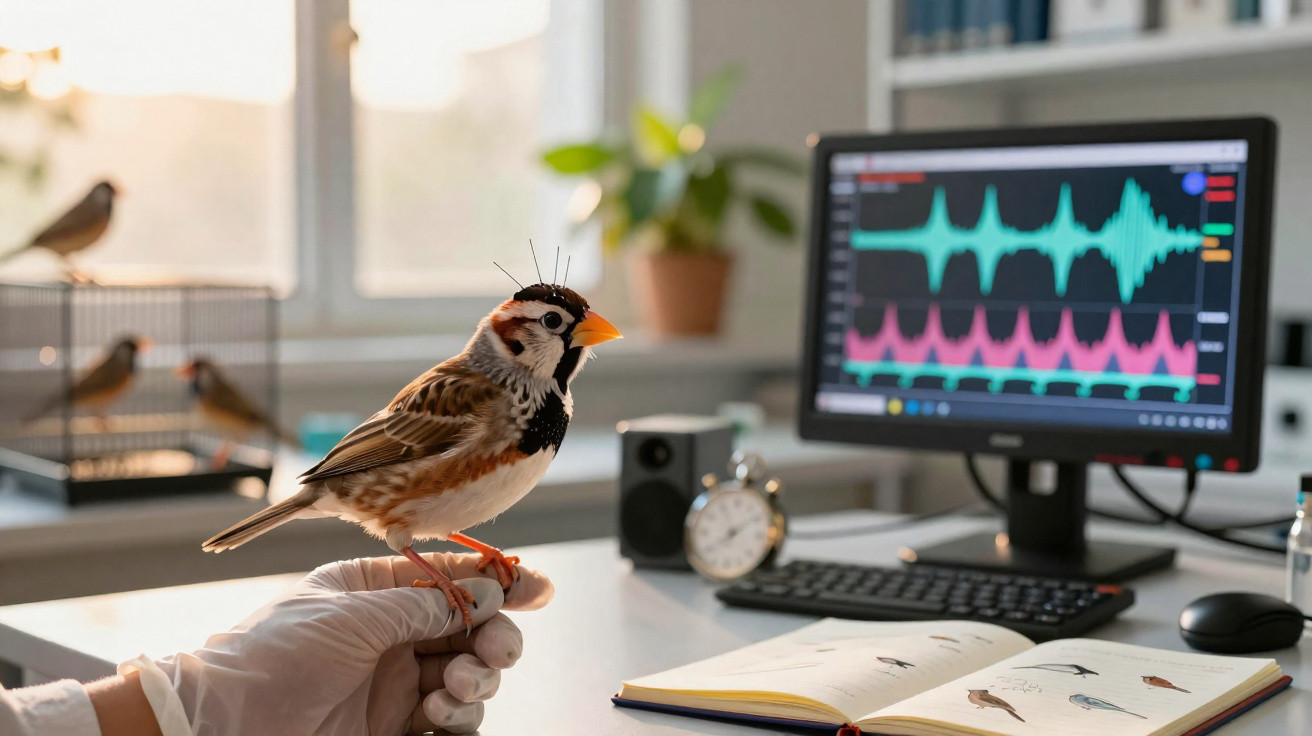
Researchers have now measured what happens in the birds’ brains during these exchanges.
Zebra finches are among the world’s most extensively studied songbirds. A new study from the Max Planck Institute for Biological Intelligence now shows just how powerfully social familiarity shapes these animals’ brains. When the birds hear a familiar call, their nervous systems follow a different, faster response sequence than they do for an unfamiliar voice – even where the calls are barely distinguishable acoustically.
A familiar voice brings a faster response
For the experiment, researchers repeatedly played short contact calls to male zebra finches. Some calls came from a bird they knew, while others were from an unfamiliar bird. The animals were free to respond as they would in an ordinary “call conversation”.
Familiar calls prompted zebra finches to reply more often, more quickly and with more precise timing than unfamiliar calls – despite an exactly identical call pattern.
Across four days of testing, a distinct pattern emerged:
- Shorter response time: Birds took an average of 354 milliseconds to respond to unfamiliar calls, compared with 306 milliseconds for familiar calls.
- More replies: Rather than responding roughly 9 times per 100 calls played, the birds answered familiar voices almost 12 times in every 100 trials.
- More consistent timing: Reply timings varied less for familiar calls, making the “turn-taking” in these exchanges more rhythmic.
Crucially, the structure of the reply calls themselves remained virtually unchanged. In other words, the birds did not alter what they said, but instead changed how promptly and reliably they answered.
What happens in the zebra finch brain
Alongside the behavioural data, the team examined a specialised brain region in the birds known as HVC. This area is recognised for controlling the timing of songs and calls.
The researchers recorded the activity of individual nerve cells as the animals listened to calls. More than 70 per cent of the cells recorded responded to the sounds at all – meaning that HVC also “listens”, rather than solely directing vocal output.
The most striking findings involved interneurons: local nerve cells that can delay or release signals.
- They fired more strongly in response to familiar calls.
- Their activity persisted for longer, precisely during the period when the bird would normally begin its reply.
- The peak of this activity shifted very little in time. Processing therefore did not begin earlier or later, but became stronger and more stable as it continued.
The greatest change occurred in the nerve cells that act like timekeepers, deciding when a call is sent back.
By contrast, projection neurons – cells that transmit signals from HVC to other brain regions – showed a much weaker response to familiarity. This suggests that the actual “social evaluation” of a call occurs in earlier auditory centres, before HVC shapes the timing of the reply.
Familiarity lies in meaning, not sound
It was already known that zebra finches can recognise individual members of their species by sound. The new study went further by testing whether straightforward acoustic differences could account for these effects. The answer was no.
Statistically, the calls played could largely be assigned to one shared sound cluster. Put another way, they generally sounded highly similar to a measuring device. Even so, the birds treated familiar callers as “special social cases”.
This narrows down the explanation: what matters is not the physical form of the tiny sound, but the experience associated with it – who is speaking to me. Depending on the relationship between the animals, the brain links acoustically similar stimuli to different meanings.
When machines read familiarity in the brain
To assess how clear-cut this signal was, the researchers used computer software to analyse patterns of nerve-cell activity. The program received only data from HVC interneurons, with no information whatsoever about the acoustic stimuli.
Using these neural patterns alone, the model achieved an accuracy rate of around 61 per cent when distinguishing familiar callers from unfamiliar ones. That is clearly above chance. When it used only the activity of projection neurons, however, the signal appeared considerably less distinct.
The patterns of interneurons encode both “familiarity” and the bird’s altered readiness to reply immediately.
The HVC signal is therefore more than an internal indicator saying, “I know this voice”; it is directly connected to the forthcoming change in behaviour.
Why timing matters so much for birds
Zebra finch contact calls are innate. Unlike their songs, the animals do not practise them for years, and they barely change their sound structure. Nevertheless, they display a form of conversational behaviour: brief calls exchanged back and forth, resembling a rapid dialogue.
These reciprocal replies usually occur within less than half a second. In such narrow time windows, the exact moment of a response becomes vital. A bird that responds too late disrupts the flow, while one that calls too early effectively “interrupts”.
Until now, HVC has primarily been known as a timing mechanism for learned songs. The new work indicates that the same circuit also seems to fit innate calls flexibly into a social rhythm, without changing the calls themselves.
| Aspect | Song | Contact calls |
|---|---|---|
| Origin | learned through imitation | innate |
| Adaptation | sound structure can be shaped | timing is adapted |
| Role of HVC | timing for melody | timing for response time |
Why the zebra finch is such a compelling model
Zebra finches are regarded as a model organism for studying vocal learning. Young males listen to adult birds, store their songs in memory and copy them step by step. In some respects, this learning process resembles how humans acquire language.
These traits make zebra finches particularly well suited to investigating circuits that connect hearing, memory and action. The new study broadens this picture: not only learned songs, but also innate calls have a socially refined component that can be measured in the brain.
For research into human communication, this offers an interesting indication: perhaps the precise moment at which we answer a question is just as important as the words we choose.
Open questions: how flexible is this social timing?
The experiments had one clear limitation: the birds’ heads were fixed while their brain activity was recorded. This allowed listening processes to be separated from movement, but it excluded genuine, freely conducted call dialogues.
That leaves several intriguing questions open:
- Does a zebra finch learn the precise timing associated with particular partners over time?
- Do earlier auditory centres already provide HVC with a “familiarity label”?
- Do stress or social rank alter how quickly a bird responds?
Future work could study birds in freely moving situations where they genuinely call back and forth. This could test whether they develop a form of “relationship ability”: not merely recognising patterns, but adjusting timing finely according to the individual they are interacting with.
What humans can learn from zebra finches
When people think about conversations, they often focus first on content: words, volume and tone of voice. The zebra finch study draws attention to a frequently overlooked factor – the precise timing of responses. Even fractions of a second can reveal whether someone matters to us or not.
This is easy to observe in everyday life. Many people reply to close friends much more quickly than they do to casual acquaintances. In online chats, video meetings and phone calls, response speed shapes whether we feel taken seriously. As with the birds, a link between social closeness and readiness to respond operates in the background.
Research using animal models such as the zebra finch helps explain the underlying circuits. One day, this may clarify why autism, social anxiety or brain injuries can disrupt not only language itself, but also the rhythm of conversation. The new study shows that even a small finch responds to familiar voices with a different internal rhythm, revealing how deeply social relationships affect the brain.















Comments
No comments yet. Be the first to comment!
Leave a Comment