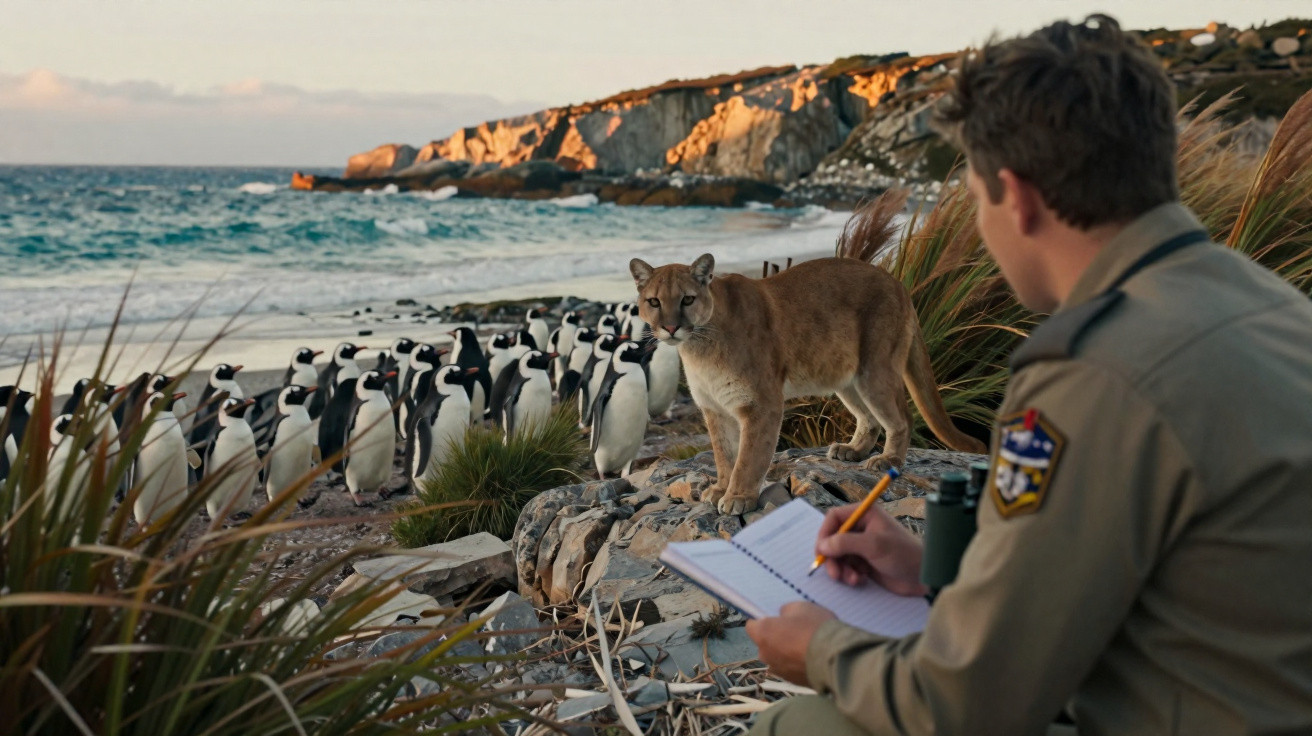
Monte León National Park, on Argentina’s Patagonian coast, faces a classic conservation dilemma: what happens when a native predator returns and threatens a prey species that settled there because predators were absent?
Following the end of cattle ranching in southern Argentina around 1990, pumas (Puma concolor) began to recolonise parts of their former range.
Meanwhile, Magellanic penguins (Spheniscus magellanicus), which had previously relied on nearby islands for safety, had started nesting on the mainland.
There, they had largely been living without major land predators. When pumas returned, the penguins became easy prey.
Counting the losses at Monte León’s penguin colony
Researchers from the Centro de Investigaciones de Puerto Deseado and park rangers have monitored the penguins since Monte León National Park was established in 2004.
Between 2007 and 2010, the researchers also counted penguin carcasses believed to have resulted from puma kills. For the new study, they joined Oxford University’s Wildlife Conservation Research Unit (WildCRU) to investigate what those figures could mean for the colony’s future.
Their estimate was stark: more than 7,000 adult penguins were killed during those four years. That represents approximately 7.6% of the estimated adult population of 93,000 birds.
The researchers were particularly concerned that most of the penguins had not been fully eaten, suggesting that many were killed for reasons other than the pumas’ immediate need for food.
“Surplus killing” by pumas
“The number of carcasses showing signs of predation we found in the colony is overwhelming, and the fact that they were left uneaten means pumas were killing more penguins than they required for food,” said lead author Melisa Lera, a postgraduate student at WildCRU.
“This is consistent with what ecologists describe as ‘surplus killing.’ It is comparable to what is seen in domestic cats when prey are abundant and/or vulnerable: ease of capture can lead to cats hunting more birds, even when they do not end up actually eating them.”
Lera said the team wanted to establish whether this behaviour could threaten the colony’s continued existence.
When prey is exceptionally easy to catch, predators can kill more than they need. The resulting losses may appear disastrous, although they do not necessarily mean the population will collapse in the long term.
Could pumas drive the penguins to extinction?
The researchers’ population models produced a surprising result: pumas alone did not appear likely to wipe out Monte León’s penguins.
The models instead indicated that the colony was much more sensitive to reproductive success and juvenile survival: how successfully the penguins breed and how many young birds live long enough to join the adult population.
Extinction appeared only in hypothetical combinations of worst-case conditions, such as a sharp fall in juvenile survival alongside very low reproductive output.
The study describes the latter as a maximum of one chick per pair. Under those circumstances, heavy predation by pumas worsened the outlook, but was not the only cause.
Carnivores encountering new prey
The issue has implications beyond Patagonia. Similar conflicts may become more frequent as ecosystems recover, predators expand their ranges and animals interact in combinations not seen for a long time.
“This study captures an emerging conservation challenge, where recovering carnivores are encountering novel prey. Understanding how these dietary shifts affect both predators and prey is essential to inform conservation,” said study co-author Jorgelina Marino of WildCRU.
The article highlights comparable examples elsewhere, including feral pigs heavily preying on loggerhead sea turtle eggs along the Georgia coast and coyotes moving onto coastal barrier islands in eastern North America.
What the park needs next
Given the apparent importance of breeding success and juvenile survival, the authors say the next major task is to determine what governs those factors.
The team plans to examine environmental conditions, including food availability, nutrients and temperature, all of which climate change can influence.
Puma predation is substantial and complicated, but the colony’s future may depend just as much, or more, on what happens to chicks and young birds.
Park authorities continue to monitor both pumas and penguins, aiming to detect any serious population decline early enough to take action.











Comments
No comments yet. Be the first to comment!
Leave a Comment