Uncommon Courses is an occasional series from The Conversation US that showcases unconventional approaches to teaching.
Course title: "The Science of Cats"
How The Science of Cats began
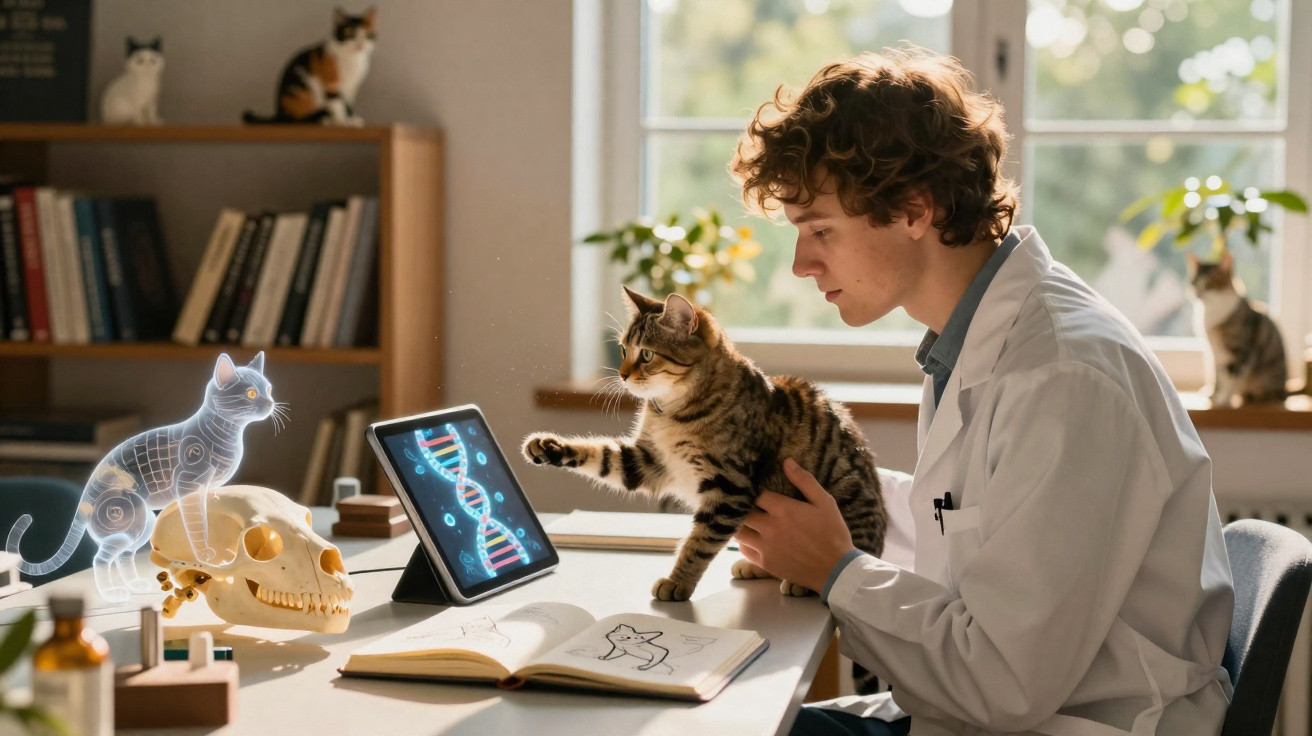
What inspired the course? As an evolutionary biologist, I have spent my career researching the evolution of small lizards in the Caribbean. I have loved cats all my life, too, but it had never occurred to me to study domestic cats scientifically.
Cats are difficult to study – have you ever tried following yours to find out what it gets up to? Unlike lions, tigers and other wild felines, which have been studied extensively, the domestic member of the cat family, Felis catus, seemed to me to be the subject of no particularly interesting research.
Twelve years ago, I found out just how wrong I was. John Bradshaw's book "Cat Sense" and the BBC's "The Secret Life of the Cat" introduced me to ailurologists who were studying domestic cats with the same advanced techniques I use for lizards and other researchers use for all sorts of creatures: GPS tracking, genome sequencing and isotopic analysis.
That discovery led to my course on the science of cats. I would attract students through their love of felines and then, while they weren't looking, teach them how scientists study biodiversity – ecology, evolution, genetics and behaviour.
What the cat science course explores
What does the course cover? At heart, it examines the past, present and future of cats: their origins, the reasons for their behaviour and what might lie ahead for them. Crucially, it also considers how we know what we know – in other words, how scientists tackle questions like these.
At the end of the course, students write an original paper or produce a mini-documentary. Their projects have covered a huge range of subjects in biology and beyond: the effects of cats on bird populations; sexism and the crazy cat lady trope; the benefits and drawbacks of living with felines for human health; hybridisation as a creative or constraining force in evolution; the top-down role of larger predators, such as coyotes and dingoes, in controlling cat numbers; and the potential for new genetic technologies to produce allergen-free cats or reduce free-roaming cat populations.
The students were not the only ones who ended up writing about cats. To my surprise, the course and its themes inspired me to write a book of my own, "The Cat's Meow: How Cats Evolved from the Savanna to Your Sofa."
Why is the course relevant now? We need more biodiversity scientists to help us understand a rapidly changing world. Cats raise scientific questions with broad appeal and can offer an introduction to biological research.
What is one essential lesson? Scientists do not have to travel to remote parts of the world to conduct important research on nature. Studying familiar animals close to home – even household pets – can yield significant advances in both basic and applied knowledge.
Learning about cats beyond the classroom
What materials and activities does the course include? Alongside reading research papers, we took field trips that were enlightening as well as enjoyable. At the crack of dawn, we joined an advocate for homeless cats who was feeding unowned felines in a run-down part of town.
An Egyptologist taught us about cats in ancient times, and we visited a cat show to marvel at the variety of breeds. We also observed wild felines at Saint Louis Zoo and looked at cats in art at university museums.
What does the course prepare students to do? Cat research gives students a way to see how scientific ideas apply to animals they know and care about deeply. As well as bringing together knowledge from many fields, students consider contemporary, real-world debates, including what to do about outdoor cats and the ethics of breeding.
Jonathan Losos, William H. Danforth Distinguished University Professor, Arts & Sciences at Washington University in St. Louis
This article is republished from The Conversation under a Creative Commons licence. Read the original article.



Comments
No comments yet. Be the first to comment!
Leave a Comment