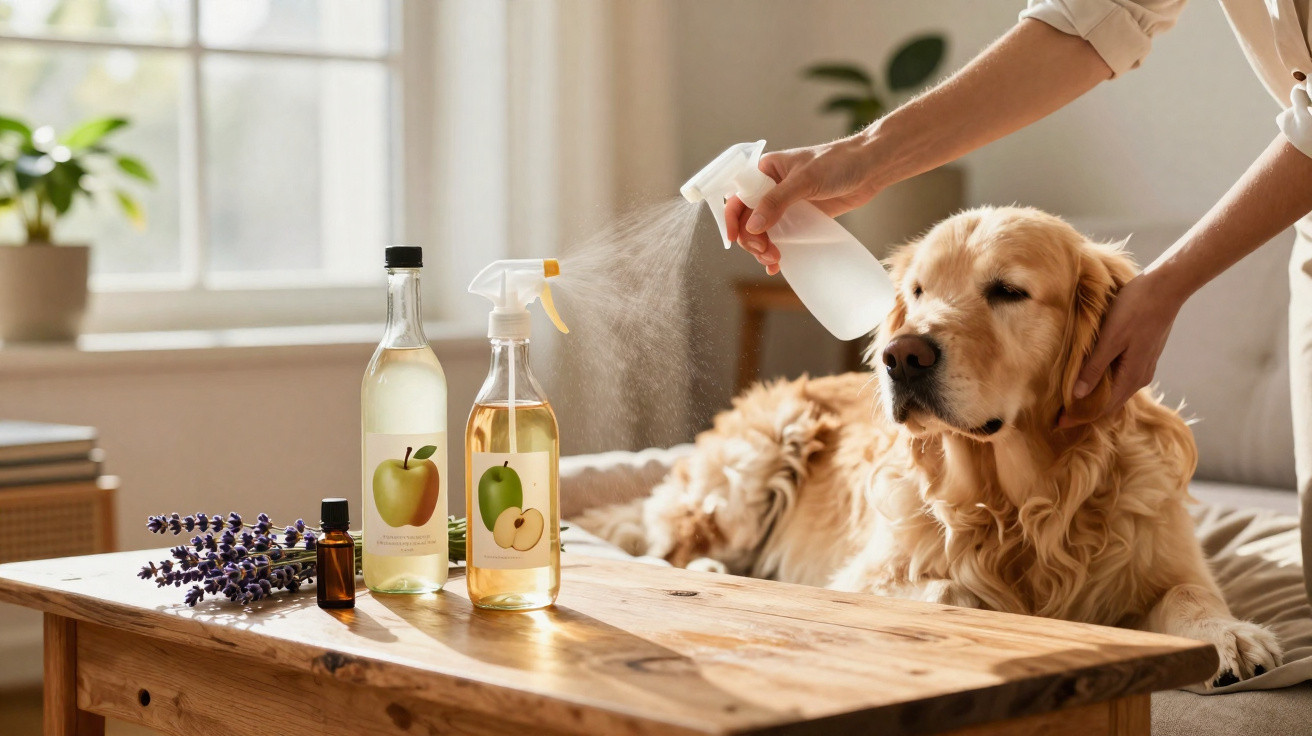
Nails click across the floor, a tail thuds, and a familiar shiver runs down your dog’s back as he tries to catch a phantom only he senses. You glance down and see a minuscule brown dot. Your heart sinks. Harsh chemicals are the last thing you want to use tonight. You reach into the cupboard, catch the scent of apple cider vinegar and spot a little bottle of lavender oil behind the tea. A neighbour had sworn this pairing worked. It seems almost too easy, yet somehow just right. You take out a spray bottle, switch on the kitchen light and start mixing like a determined home bartender. The room smells like a garden met a salad bar. You give your dog a light spritz, work it through his coat and wait. The clicking eases. His gaze grows calmer. It has worked-mostly.
Why this straightforward blend belongs in your kitchen-and around your dog
Apple cider vinegar has a crisp, sharp smell that fleas dislike. When properly diluted, it should not strip your dog’s skin, while its tangy aroma disappears more quickly than you might expect. Lavender oil adds a soothing floral fragrance that many people use as a natural deterrent. Combined, they are not a magical protective barrier. Instead, they offer a gentle signal that says, “Not here.”
Most of us have experienced a quiet Sunday becoming a full flea-control operation, with the vacuum roaring while a cup of coffee turns cold. One reader said she sprayed a diluted ACV-lavender blend on her dog’s legs before walks for two weeks, then used a comb afterwards. The number of fleas caught in the comb fell from ten to two. It was not a laboratory study, merely a modest household success. But on an ordinary street and in everyday life, that sort of improvement counts.
The process itself is fairly simple. Fleas respond to scent and survival cues, and the acidity of vinegar alongside lavender’s aromatic compounds makes the environment less appealing. ACV will not eliminate an established infestation by itself, and lavender is not a pesticide. It is more like moving seats at an insect dinner table. Treat it as a way to improve the odds each day, rather than a lottery win achieved all at once.
Apple cider vinegar and lavender flea spray: the practical recipe
For dogs older than 12 weeks, begin with a straightforward mixture: combine 1 cup of apple cider vinegar and 1 cup of cool water in a clean spray bottle. For additional fragrance, use 1 drop of high-quality lavender essential oil for every cup of liquid. Shake the bottle before each application. Mist your dog’s coat lightly, keeping it away from the eyes, nose and genitals, then brush the mixture through. Apply it before walks or after time outdoors. Around the home, use the same vinegar-and-water base without oil to spray bedding, crates and doorways. Treat it as a repellent, not a cure.
The usual mistakes are unexciting but predictable. Some people add too much oil, spray near the face or expect the mixture to remove an infestation overnight. Avoid doing this. Use only a light amount, apply it section by section and carry out a small patch test on your dog’s shoulder first. Combine the spray with flea-combing around the neck, the base of the tail and the belly. Vacuum carpets, hot-wash bedding and repeat the routine. Realistically, few people manage all of this daily. During peak flea season, aim for most days and do not worry about the occasional missed day.
“The spray is your daily shield, the comb is your truth-teller, and the vacuum is your cleanup crew,” a groomer told me, wiping a brush on a towel. “Skip one, and the fleas will find the gap.”
- Never apply undiluted essential oils to pets.
- For dogs, 1 drop of lavender oil per 1 cup of diluted mixture is sufficient. For sensitive dogs, leave out the oil.
- Cats and essential oils do not go together-leave out the lavender for them. Use diluted ACV on bedding only, never on the cat.
- Keep sprays away from eyes, mouths, broken skin and irritated areas.
- Stop using the mixture if redness, scratching or lethargy develops. Contact your vet if symptoms continue.
What this flea routine changes at home-and what it cannot do
Fleas are not found only on your pet. Many remain unnoticed in carpets, crevices and fabrics as eggs and larvae. Your spray discourages the adult fleas, while laundry and vacuuming disrupt the life cycle. Letting bedding sit in daily sunlight shifts the conditions from “welcome” to “why bother.” Homes recover through these small actions repeated over time.
There is both sensible science and clear limitation here. ACV has an acidity of roughly pH 2–3, which is why dilution matters for skin comfort. Lavender contains linalool and linalyl acetate, aromatic compounds that insects dislike. The supporting evidence is mainly practical rather than perfectly peer-reviewed. This is not a replacement for a medicine cabinet; it is a tool for gently shifting the balance. If you need a reliable reset, speak to your vet about modern flea control, then use this mixture for maintenance.
Dogs generally cope well with light sprays that have been correctly diluted. Cats require a separate discussion, as their livers process substances differently and even tiny amounts of essential oil can pose risks. For cats, omit lavender oil altogether and restrict ACV use to items such as blankets, beds and soft carriers, allowing them to air-dry before the cat returns. This keeps residue off their fur while still making the surroundings less favourable to fleas.
A manageable plan with room to breathe
There is reassurance in taking small, practical actions. Keep a bottle by the back door, a comb beside the sofa and ACV in the pantry. As the week goes on, the routine feels less like a battle and more like a rhythm. Fleas may still be around, but they no longer control the household.
Share the task with the rest of your home routine: shake the dog bed outside on the porch, open a window and hot-wash whatever you can once a week. If fleas become widespread in your area during warmer months, continue with the mixture and the vacuuming routine. Introduce one habit at a time. Your dog settles more easily. You scratch less. And if a friend sends a panicked close-up of a flea on a sock, you will have a calm response-and a recipe with the scent of a summer garden.
| Key point | Detail | Benefit for the reader |
|---|---|---|
| Safe dilution | 1 cup ACV + 1 cup water; 1 drop lavender oil per cup for dogs only | A simple, repeatable ratio that can be mixed in minutes |
| Species caution | No essential oils on cats; use the ACV mix on bedding only, not on the animal | Protects pets while still improving the environment |
| Whole-home routine | Spray, comb, vacuum, hot-wash fabrics, sunlight on bedding | Interrupts the flea life cycle rather than merely chasing symptoms |







Comments
No comments yet. Be the first to comment!
Leave a Comment