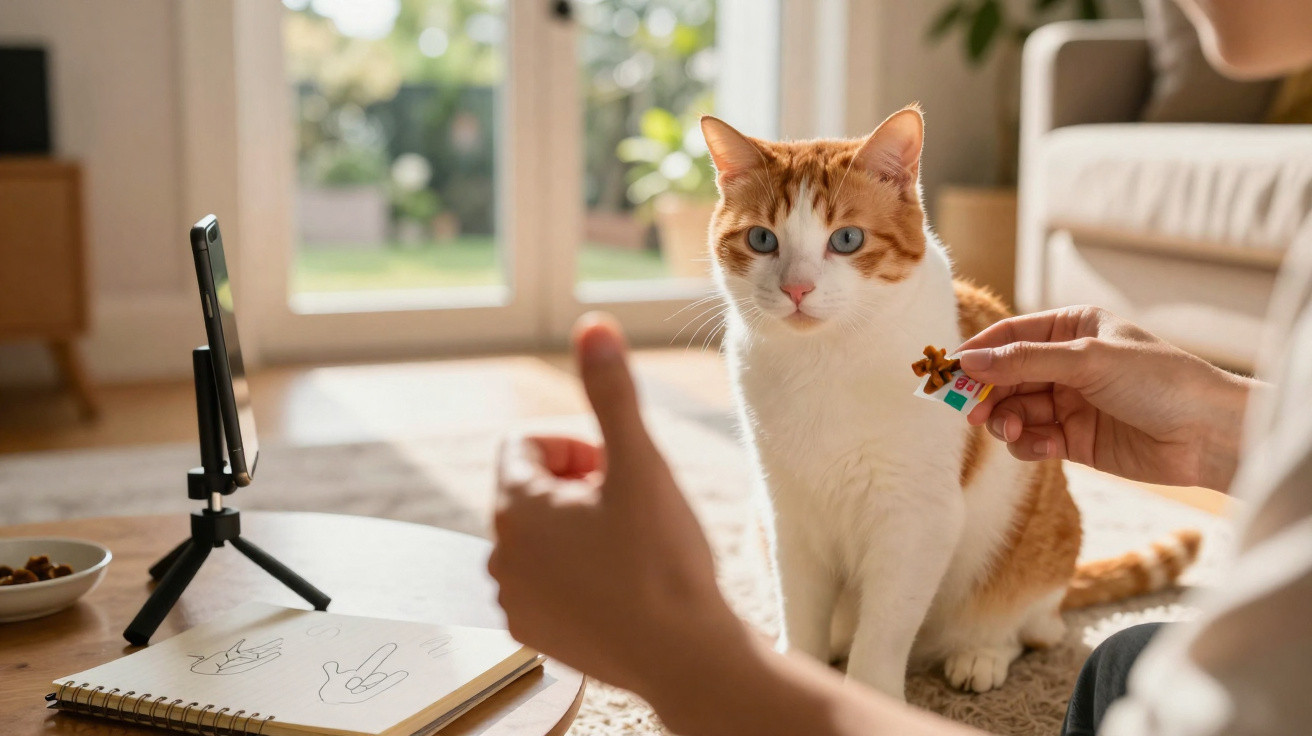
A white cat with differently coloured eyes, an inventive young owner and a quiet flat gradually becoming full of meaning.
Huckleberry, a deaf rescue cat adopted towards the end of 2025, has captured hearts online while his owner patiently creates a small shared language made entirely of hand signs.
A deaf cat who will not be defined by limits
Huckleberry is a remarkable white cat with heterochromia, meaning that his eyes are different colours. He is also entirely deaf, which is common in white cats with blue eyes; however, both of his ears are affected.
His circumstances changed in late 2025, when a young woman adopted him and took him home. Initially, the silence between them was quite literal: he could not hear her voice, and she understood that calling out his name would achieve nothing.
Rather than depending on sound, she chose to develop their bond through sight, movement and touch. That choice has since made Huckleberry a modest TikTok star on @huckleberry.cant.hear, an account with more than 8,000 followers.
Huckleberry’s disability did not close a door; it pushed his owner to invent a new way of talking to him.
Why Huckleberry’s owner chose sign language
Huckleberry’s owner quickly recognised that conventional training based on spoken commands would serve no purpose. She required an approach built around his strengths: keen vision, sensitivity to movement and an evident desire to engage.
She began learning sign language herself before adapting signs to communicate with her cat. In one video, she says that they are both still learning, and warmly invites viewers to offer advice and patience along the way.
Her aim was straightforward yet ambitious: to help Huckleberry connect clear, repeated hand signs with actions, needs and daily routines. Gradually, those signs would form their shared “vocabulary”.
The first word: “outside”
Videos shared in early February 2026 show that the first sign Huckleberry properly understood was “outside”. Since he enjoys going for walks, his owner decided to begin with that cue.
Whenever she uses the particular gesture for “outside”, Huckleberry understands that something exciting is about to happen. He approaches her, waits for his harness and prepares for a walk on his lead.
The “outside” sign turned a simple outing into a conversation: a silent question from the cat, and a clear answer from the hand.
For his protection, he always goes out wearing a harness and lead. As deaf cats cannot hear traffic, dogs or unexpected sounds, allowing them to roam freely may be dangerous. The “outside” sign lets him experience outdoor stimulation without exposing him to avoidable danger.
Huckleberry’s journey from basic cues to complete trick routines
After establishing the first sign, the pair progressed beyond simple recall. His owner started matching further gestures to actions, creating an expanding range of cues that Huckleberry could recognise and carry out.
TikTok viewers can watch him react to a variety of hand signs accurately and eagerly.
- Turning in a circle when prompted
- Giving his paw to touch her hand
- Leaping over a low obstacle
- Crawling or stepping beneath a barrier
- Sitting in front of her
- Lying down and relaxing on cue
Every behaviour is connected to one reliable gesture. His owner maintains a calm stance, makes distinct movements and gives immediate rewards. Together, these create a flowing sequence that resembles a carefully choreographed dance between a person and a cat.
What many people call “tricks” are, for Huckleberry, proof that he can understand, participate and succeed.
Brief sessions, significant progress
His development came through numerous short, repeated training sessions, rather than lengthy and tiring ones. Focused sessions help a deaf animal remain interested without becoming overwhelmed, stressed or confused.
Huckleberry’s owner rewards him with treats and touch, linking the sign, behaviour and reward. Although sound is absent, the pattern becomes understandable for him. His curiosity and willingness to please help him learn more quickly.
How deaf cats learn in different ways
Deaf cats are frequently especially aware of visual and physical information. They can notice shadows, vibrations and facial expressions with greater intensity, and Huckleberry appears to follow this pattern.
For carers, this means communication should centre on:
- Visual cues: hand signals, body posture, lights
- Touch: gentle taps, stroking, vibration on the floor
- Routine: predictable feeding times, walking rituals, play windows
Rather than raising your voice, use a hand movement. Instead of calling a cat’s name, move into its sightline or gently tap a nearby surface to produce vibrations it can feel.
Social media’s role in Huckleberry’s story
Huckleberry’s TikTok account offers more than entertainment. Each short video acts as a small lesson in sharing life with a deaf pet.
In a popular video posted on 6 February 2026 and shared by pet news outlet Parade Pets, his owner demonstrates the “outside” sign. Huckleberry responds immediately, holding his tail high and appearing clearly thrilled by the visual signal.
Another clip makes a training session resemble a quiet classroom. The cat follows every movement as she signs. He spins, gives a paw, moves over obstacles, then settles into either a sit or down position when asked.
These videos normalise disability in animals and show that deafness calls for adaptation, not pity.
What Huckleberry’s experience means for other pet owners
Huckleberry is far from the only deaf cat. Many are placed in shelters because prospective owners fear that they will be difficult to train. His achievements indicate otherwise.
Cats, including those with disabilities, can learn rapidly when training draws on their natural abilities. Food rewards, play, regular routines and clear visual cues can be effective for most cats, regardless of whether they can hear.
Pet behaviour specialists note that sign training may also help hearing cats. Hand signals can be understood in noisy places, used from across a room and prove less confusing than words that change repeatedly.
| Method | For hearing cats | For deaf cats |
|---|---|---|
| Verbal cues | Useful but often inconsistent | Not usable |
| Hand signals | Clear at a distance | Primary communication tool |
| Touch cues | Extra reassurance | Helps startle less, builds trust |
Practical guidance inspired by Huckleberry
For people thinking of adopting a deaf cat, Huckleberry’s training provides a useful starting point:
- Choose uncomplicated, clearly different hand signs, using the same sign for every action each time.
- Begin with strongly motivating cues, such as “food”, “play” or “outside”.
- Reward every correct response with a treat, toy or affection.
- Approach your cat within its field of vision so that it is not startled.
- Keep cats that cannot hear indoors, or use a harness and lead when taking them outside.
There are genuine risks: a cat without hearing may not notice approaching cars, dogs or sudden hazards. This is why Huckleberry’s owner does not allow him to roam outdoors freely, despite how much he loves walks. His lead is more than a requirement; it is a lifeline.
Wider lessons about communication with animals
Huckleberry’s experience underlines a wider observation about animal intelligence. Many pets can learn detailed associations, gestures and routines when people are willing to teach them patiently and clearly.
For hand signals to be effective, they do not need to be official sign language. Consistency is what matters. While some owners use signs from American Sign Language, others create their own; for the animal, significance comes through repetition and the connection between a gesture and its result.
Using sign language with pets also prompts thought for families who rely on it daily. In homes with deaf or hard-of-hearing people, including animals in signed routines can create a stronger sense of unity, as everyone shares the same communication method, at least in part.
For children in particular, teaching a pet through signs can offer a practical way to develop patience, empathy and observation. They learn that slight differences in movement may alter a message, and that animals respond differently when a signal is unambiguous.
Behind the viral clips sits a quiet message: communication is not limited to sound, and relationships are not limited by disability.
As Huckleberry learns further signs, his story continues to demonstrate how small everyday gestures can create real understanding, even in total silence.















Comments
No comments yet. Be the first to comment!
Leave a Comment