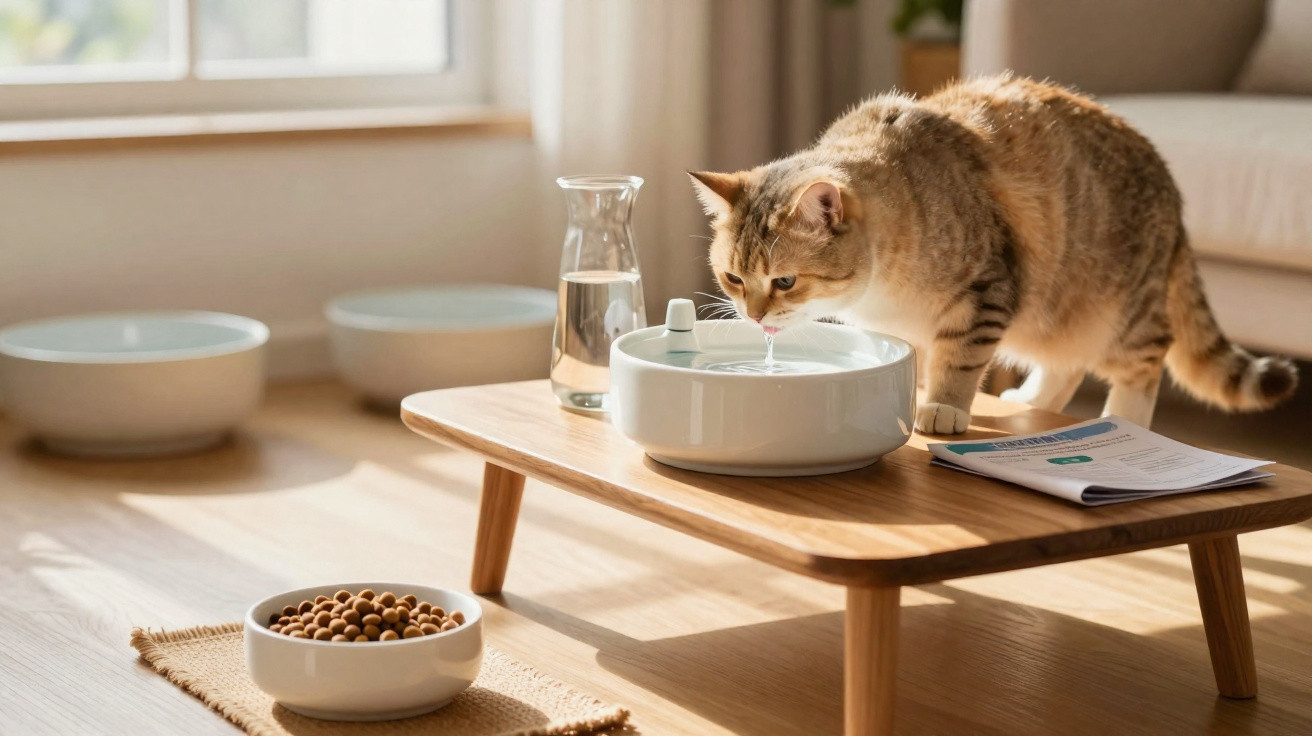
Many cat owners become frustrated: the food bowl is full, the water is clear – yet the cat simply walks past it.
The cause is often a straightforward but consequential mistake.
While people notice thirst clearly, cats tend to recognise a lack of fluids only very late. If they also avoid their water bowl, their body is affected quietly – particularly the kidneys and urinary tract. One detail in the home can be enough for a cat to register the bowl as “dangerous” and choose to drink very little, or drink elsewhere instead.
Why cats ignore the water bowl
Domestic cats retain a desert heritage. Their ancestors lived in arid regions and obtained most of their fluids from prey. They rarely needed to drink actively, and their sense of thirst remains far less pronounced than ours.
In a cat's mind, eating and drinking are two strictly separate activities. In nature, a carcass is seldom found right beside a safe source of water. An animal that drinks near partly decomposed prey risks exposure to bacteria and pathogens. That safety mechanism is still at work today.
“If the water bowl is placed directly beside food or even the litter tray, instinct says: ‘Better not drink here.’”
As a result, many cats avoid the bowl even when it appears clean. They may take just a few sips – or turn instead to the watering can, a dripping tap or puddles on the balcony.
The single mistake that gradually puts strain on the kidneys
The most common issue in German homes is placing food and water bowls close together, often near the litter tray as well. It may be convenient for people, but for a cat it amounts to a “hygiene alarm”.
The situation becomes even more problematic when the placement itself is unsuitable:
- a bowl in a noisy corner (washing machine, children, hallway, slamming doors)
- a cramped alcove with no escape route
- directly against a wall, so the cat can approach from only one side
- a bowl of still, slightly warm water that has not been refreshed for a long time
Many cats simply do not feel safe in such places. If a cat feels threatened or trapped while drinking, it is more likely to decide not to drink at all. The problem is that this avoidance often goes unnoticed for a long time, while the consequences develop internally.
How drinking too little affects a cat's body
Veterinarians give a broad guideline: a healthy cat should take in around 40 to 70 millilitres of water per kilogram of body weight each day – including moisture from food. A 4-kilogram cat therefore needs roughly 160 to 280 millilitres daily.
If the cat mainly eats dry food, its need for additional water rises considerably. When it also drinks poorly, its urine becomes highly concentrated. This can encourage:
- urinary stones and urinary crystals
- painful bladder infections
- kidney damage, including chronic kidney disease
“The most dangerous combination is: lots of dry food, little water, a poorly accessible bowl – and unfortunately this applies to many indoor cats.”
From the outside, a cat may seem normal for quite some time. The warning signs are usually subtle:
- less urine in the litter tray and smaller clumps
- spending a long time in the tray, sometimes meowing while crouching
- frequent licking around the genital area
- a dull-looking, less glossy coat
- reduced interest in play and general lethargy
The heating season, dry indoor heating air and the first early-summer days all increase the risk. The body then loses more fluid through breathing and skin without the cat automatically drinking more.
Creating the ideal drinking spot for your cat
Distance from the feeding area – the most important adjustment
The first step is simple and is often decisive: keep food and water clearly separate. They should be at least two metres apart; ideally, they should even be in different rooms. The water bowl does not belong beside the food bowl or next to the litter tray.
Many owners report that their cats drink noticeably more within a few days after the bowl is moved to a quieter, separate location.
Offer several drinking stations around the territory
Cats divide their home into zones: sleeping areas, feeding areas, play spaces and lookout spots. It is worth providing a water bowl in each of these places. Studies show that cats take in noticeably more fluid when they encounter appealing water sources several times as they move around the home.
Particularly suitable options include:
- sturdy, wide bowls made from glass or ceramic
- shallow containers where the whiskers do not touch the sides
- locations with a clear view and at least one escape route
- generally quiet areas without constant noise
Why many cats dislike deep or plastic bowls
Many cats find contact with their whiskers unpleasant. If their whiskers are pressed firmly against the edge while drinking, it causes stress. Deep, narrow bowls are therefore often unappealing. Wide, shallow dishes are much more inviting.
Plastic bowls can also absorb odours easily. To a cat's sensitive nose, the water in them can quickly smell “odd”, even when people cannot detect anything. Glass and ceramic stay neutral and can be cleaned more thoroughly.
Fresh water: change it more often, prevent more problems
Water should be replaced with fresh water at least twice a day. Still water deteriorates more quickly, especially in summer and in warm homes, particularly when food crumbs or dust fall into it.
“The fresher the water, the more likely a cat is to accept the bowl as a safe drinking source – old puddles in the garden can sometimes seem more attractive to them than stale water in a bowl.”
When washing the bowl, it is best to avoid strongly perfumed washing-up liquid, or rinse it exceptionally well afterwards. A strong scent may deter a cat from drinking even if the water itself is clean.
Water fountains and other tricks for cats that drink reluctantly
Running water as an attraction
Many cats are fascinated by the tap and would rather drink from the stream than from a bowl. A water fountain can help here. The gentle trickling encourages many cats to lap, while the movement seems more interesting than a still, smooth surface.
The same applies to fountains: change the water daily, clean filters regularly and remove deposits from the unit. Otherwise, what is meant to support health can become a breeding ground for germs.
Increasing moisture through food
Anyone feeding their cat mainly dry food should consider changing the diet or combining foods. Wet food has a very high moisture content, which automatically reduces strain on the kidneys and urinary tract.
These small measures can also help:
- add one tablespoon of lukewarm water to the portion of dry food
- mix wet food with a little extra water
- make one to two portions of wet food a fixed part of the daily feeding routine
Many cats accept this without difficulty, although some need a few days to adjust. Increasing the amount gradually raises water intake gently and permanently.
When a visit to the vet is necessary
If, over several days, you notice that your cat is hardly drinking at all, the litter tray is unusually dry or the cat seems to be in pain, do not wait too long. Blood in the urine, straining to urinate, or repeatedly visiting the litter tray but producing only a few drops are warning signs that require urgent veterinary help.
Urinary blockage can become life-threatening, especially in male cats. Every hour matters. Senior cats, overweight cats and animals with existing conditions such as diabetes or known kidney problems are also especially sensitive to fluid deficiency.
How to monitor your cat's drinking behaviour effectively
One easy method is to count the clumps in clumping litter each day or, with non-clumping litter, observe how often the cat uses the tray. Make a rough note of how frequently you top up the water and whether it is genuinely disappearing or mostly evaporating.
Kitchen scales can be useful: put a measured amount of water into the bowl, weigh it, then check again after several hours or in the evening to see how much has actually gone. This gives you a sense of whether your cat is within the normal range or drinking significantly too little.
Why this one placement error has such a major effect
Ultimately, much depends on a seemingly minor issue: the location and design of the water bowl. When the bowl is in the wrong place, the cat perceives it as an unsafe, potentially contaminated source. Its reluctant-to-drink desert animal instinct then says: “Better leave it.”
Keeping feeding areas, the litter tray and drinking spots properly separate, providing several water sources, ensuring fresh, cool water and choosing the right vessel can significantly reduce the risk of kidney and urinary tract disease. Many cats then start drinking far more on their own – without any pressure, simply because the conditions are finally right.





Comments
No comments yet. Be the first to comment!
Leave a Comment