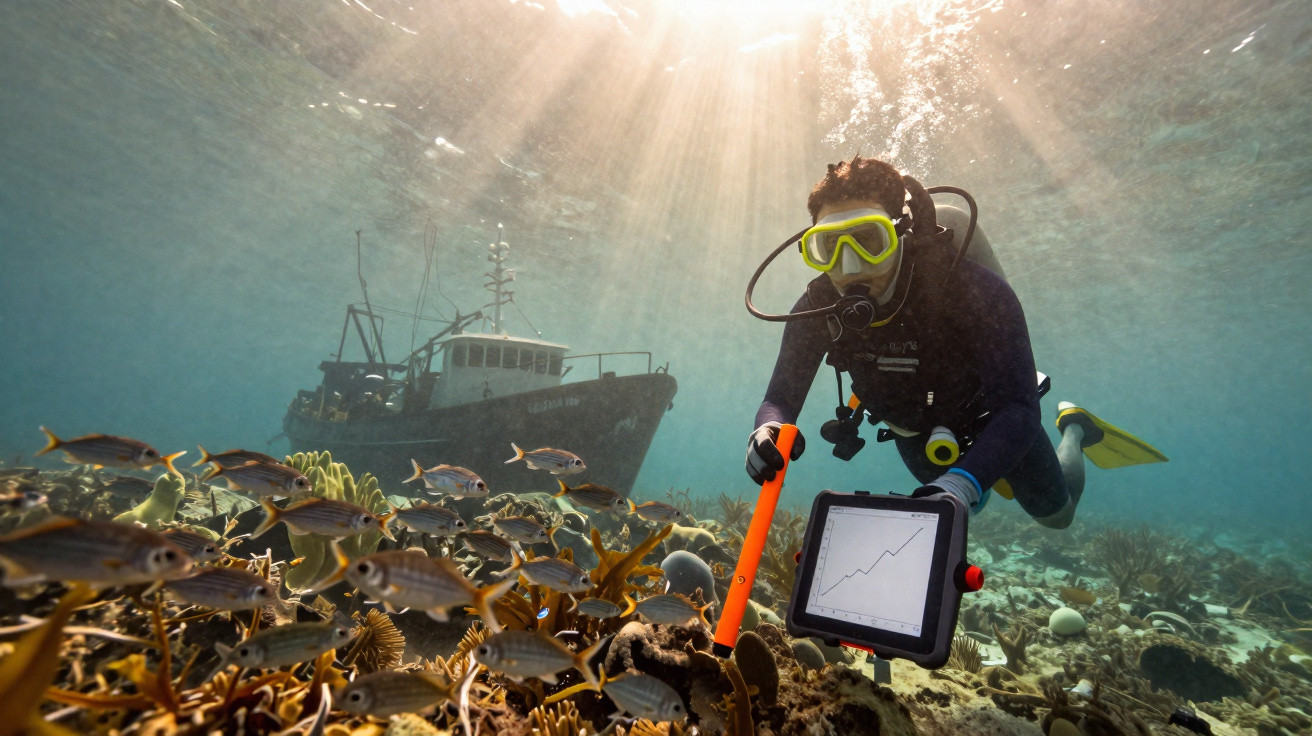
New research findings reveal how severely even very small temperature rises can deplete fish stocks in the North Atlantic and neighbouring seas. What sounds like an almost imperceptible tenth of a degree becomes, over decades, a dramatic loss of marine life, with consequences for food security, fisheries and entire coastal regions.
What the study found
An international research team examined roughly 33,000 fish populations across the Northern Hemisphere’s oceans in a study published in Nature Ecology & Evolution. It covered the period from 1993 to 2021. Crucially, the researchers distinguished between long-term warming at the seabed and short-lived extremes such as marine heatwaves.
With every rise of just 0.1 degrees Celsius per decade in seabed sea temperature, fish stocks decline by an average of 7.2 per cent.
The analysis also indicates that biomass losses caused by persistent warming can reach almost 20 per cent in individual years. Here, biomass means the combined weight of every fish in a population: not simply the number of individual animals, but the population’s total size by weight.
Why seabed temperatures matter for fish stocks
Many commercially significant species, including cod, haddock, flatfish and deep-sea species, live, feed or spawn close to the seabed. This is precisely where temperatures are rising gradually but continuously.
- Warmer water holds less oxygen.
- Many species can withstand only a narrow range of temperatures.
- Food chains are disrupted when plankton and small animals move elsewhere.
- Heat stress leaves fish more vulnerable to disease.
The faster seabed temperatures rise, the less time species have to adapt or move into cooler waters. Most concerningly, the losses accumulate, even where the annual decline initially appears modest.
Small temperature change, major impact
A tenth of a degree may sound insignificant. People would not notice it in everyday life. Marine organisms experience it very differently:
What appears to be a minor shift in the laboratory adds up to a massive biological haemorrhage across entire ocean basins.
The researchers stress that this cumulative effect is particularly underestimated. Across several decades, an apparently small percentage can turn into a collapse from which stocks struggle to recover, especially where fishing continues at the same time.
Misleading effect: when heatwaves appear beneficial
The study identifies another sensitive mechanism. Short-term marine heatwaves can cause local populations to grow, masking the underlying problem.
Sprat stocks provide one example:
- In the warm Mediterranean region, a heatwave pushes fish towards the limit of what they can tolerate, making a population decline more likely.
- In the much cooler North Sea, the same spell of warmth may temporarily improve living conditions, allowing stocks to increase.
Such shifts can create the impression that “overall, things are still going reasonably well”. The study warns that this very misreading could distort fisheries policy and management decisions.
Why this can lead to poor decisions
If authorities react only to short-term increases, misinterpretation is almost inevitable:
| Short-term impression | Actual long-term trend |
|---|---|
| More fish in a fishing area after a heatwave | Total ocean biomass continues to decline |
| Individual species “move northwards” and appear stable | Species at the warmer edge of their habitat collapse |
| Catch volumes remain high for a short period | Yields fall in the medium to long term |
Spanish ocean specialist Carlos García-Soto therefore describes a “dangerous constellation” for fisheries governance: the underlying trend is clearly downward, while occasional upward movements create an appearance of stability.
Climate heating meets already overfished seas
Alongside warming, the oceans face a long-established problem: overfishing. According to the UN Food and Agriculture Organization, the share of overexploited stocks continues to rise worldwide.
What was once primarily a fisheries problem has now become a double pressure of fishing intensity and the climate crisis, compounded by declining oxygen in the water.
So-called deoxygenation, the reduction of oxygen levels in the sea, intensifies the problem. Fish need more energy to breathe, move less, grow more slowly and spawn successfully less often. Warming, overfishing and oxygen depletion therefore interact, accelerating the fall in fish stocks.
Record ocean heat: what 2023 showed
A separate study in Nature Reviews Earth & Environment found that ocean heat content reached new record levels in 2023. Heat content refers to the total amount of energy stored in the seas, and this quantity has risen almost continuously since the 1960s.
The effects extend far beyond fish:
- Coral reefs bleach more frequently and die off.
- Storm events can intensify because the system contains more energy.
- Sea-level rise accelerates as warmer water expands and glaciers melt.
- Current systems such as the Gulf Stream may change, with unpredictable effects on Europe’s climate.
The combination of record heat and gradual warming at the seabed makes one thing clear: this is not only about spectacular extreme events, but about a structural, continuing transformation of the entire ocean ecosystem.
What “every tenth of a degree” means in practice
Climate researchers have repeated for years that every small reduction in warming makes a difference. The fish study offers a vivid underwater example:
If the pace of ocean warming slows, we lose less fish biomass. Even small reductions in emissions have a measurable effect on stocks.
Conversely, if the increase accelerates by only another tenth of a degree per decade, an already pressured system moves even faster into a range where conventional fisheries rules no longer work. No protected area or catch quota can then easily compensate for the damage caused by heat.
What this means for food and the economy
Worldwide, hundreds of millions of people obtain a substantial share of their protein from fish and seafood. Coastal regions, from Norway to West Africa and from Japan to Chile, depend directly on stable stocks.
A sustained decline in fish biomass can:
- reduce catches and threaten livelihoods in the fishing industry;
- raise prices for consumers;
- intensify conflicts over fishing rights and shifts in fish migration;
- fuel illegal fishing when legal catches collapse.
For German-speaking countries, this means that even though much of their fish is imported, global declines directly affect supermarket prices, security of supply and jobs in processing.
A few technical terms explained clearly
What is a marine heatwave?
The term describes a period in which sea temperatures at a particular location remain significantly above the long-term average for several days or weeks. Like heatwaves on land, they are now occurring more often and with greater intensity. For marine organisms, this means stress, altered spawning periods, changed migration routes and, at times, mass mortality.
What does biomass mean in the sea?
Biomass does not measure the number of individual animals, but their combined weight. This measure is vital to fisheries because it shows how much overall ‘substance’ a stock contains. When biomass falls, a stock may still look healthy in the short term, yet it becomes more vulnerable to collapse following disruptions such as heat events or intensive fishing.
What is now at stake
The current studies do not portray an abstract future scenario, but a process that is already under way. Step by step, the oceans are losing their role as a reliable provider of food, oxygen and climate protection, particularly if greenhouse-gas emissions barely decline.
The more warming is restrained, the greater the scope for stabilising fish stocks through sound management, protected areas and less overfishing. If no brake is applied, the researchers’ simple calculation holds true: more heat in the sea means fewer fish, and at a faster rate than many have previously assumed.
















Comments
No comments yet. Be the first to comment!
Leave a Comment