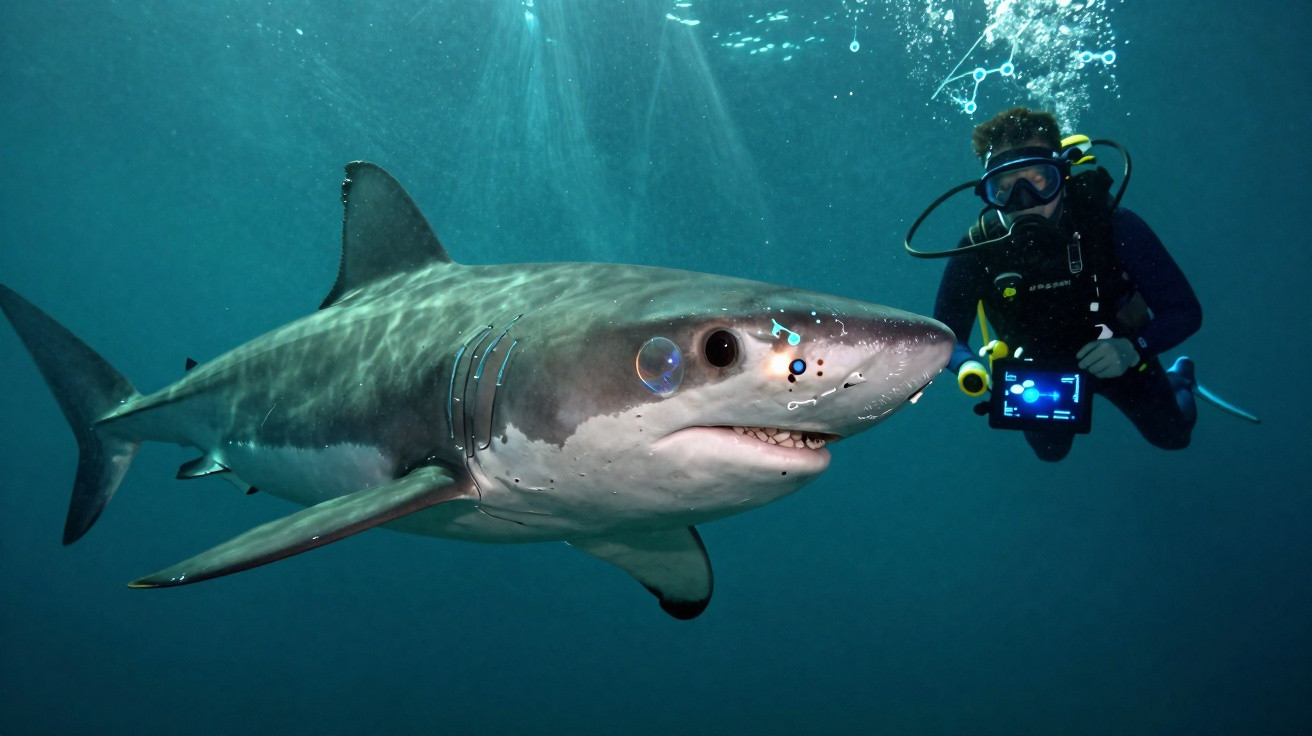
A fresh study of the eyes of some of Earth’s longest-living animals may reveal molecular insights into how vision can endure for decades.
Greenland sharks retain vision in deep water
For years, scientists believed Greenland sharks (Somniosus microcephalus) had extremely limited vision, if any. The animals spend much of their centuries-long lives in the ocean’s dark depths and frequently carry parasites on their corneas.
Researchers from the United States, Switzerland and Denmark have now shown that Greenland sharks can see, and that their visual systems remain functional for a remarkably long period.
The discovery indicates that part of the sharks’ notable DNA-repair toolkit, which has been associated with their exceptional longevity, could help keep their retinas unusually healthy. Whether this could hold any relevance for human eye health remains uncertain.
How Greenland shark eyes are adapted to darkness
The study examined eyes from Greenland sharks captured and euthanised between 2020 and 2024 under a research permit granted by the territory’s government. All of the sharks were estimated to be more than 100 years old, while the oldest was thought to be over 130 years old.
Greenland sharks typically inhabit deep water, at depths of up to 1,200 metres (3,940 feet), though they are capable of diving further. Light is scarce at these depths: from 100 metres downwards, the amount passing through the water column declines sharply, and below roughly 1,000 metres there is effectively no sunlight.
Those conditions, together with the common presence of eye parasites, had persuaded many scientists that the fish could survive with minimal or no visual acuity. However, the team’s molecular, genomic and tissue-structural assessment of Greenland shark eyes points to a different conclusion.
Vertebrate retinas generally contain rods and cones, two forms of light-detecting cell. Rods are tailored to seeing in dim conditions, whereas cones enable colour vision in brighter light. Greenland shark retinas entirely lack cones, an adaptation also seen in a small number of species that spend most of their lives in low-light environments.
The scientists also analysed rhodopsin, the highly light-sensitive protein in rod cells that is vital for vision in darkness. In Greenland sharks, rhodopsin sensitivity is greatest at approximately 458 nanometres, matching the blue wavelength at which the weak light reaching their habitat is most intense.
Healthy retinas in sharks over 100 years old
The retinas examined by the researchers appeared healthy and showed no evidence of degeneration, including in sharks aged over 100 years. The DNA-repair process that may preserve them has not yet been investigated. Measurements of the cornea also indicated that it continues to transmit most incoming light, even with a parasite attached.
Collectively, the findings suggest that Greenland sharks are exceptionally adapted to continuous night vision in the ocean’s dark depths.
"Our findings support the presence of a preserved and functional visual system in the adult Greenland shark, which seems well-adapted to extreme low-light conditions," the researchers write in their paper.
"The Greenland shark provides a striking example of long-term preservation of retinal integrity, supported at both molecular and histological levels, and highlights the extraordinary potential for neuronal maintenance in extreme longevity."
The research has been published in Nature Communications.













Comments
No comments yet. Be the first to comment!
Leave a Comment