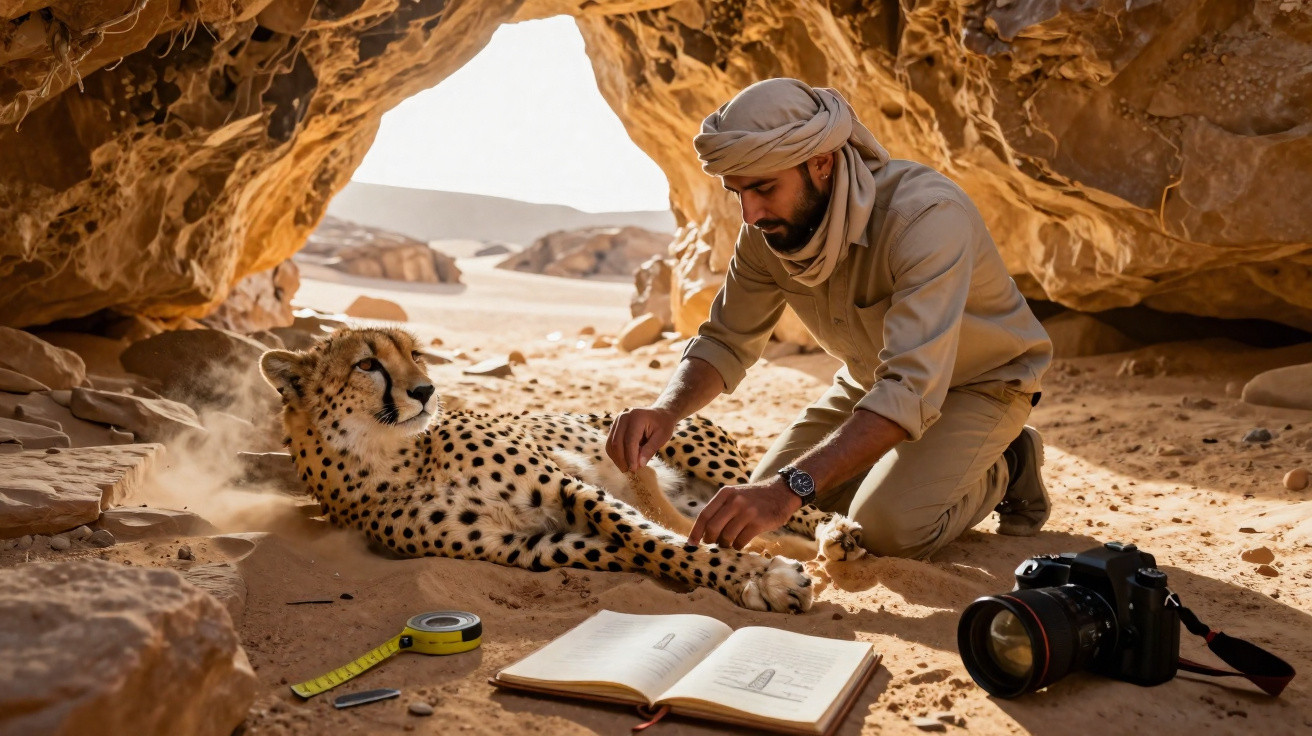
Mummified cheetahs discovered in a cave near Arar, in northern Saudi Arabia, have become one of the rarest finds in recent palaeontology. What makes the discovery so striking is not merely that these big cats were found in a rocky shelter, but that skin, tissue and bone structure survived in an arid, dry setting that is generally unfavourable for the preservation of complete large-predator carcasses.
Why is this cave discovery so surprising?
The cave examined by researchers belongs to a network around Arar and yielded evidence that is highly unusual in records of ancient fauna. Rather than scattered fragments, scientists recovered nearly complete bodies displaying unmistakable signs of natural mummification. This form of preservation is rare in large mammals, as decay, seasonal moisture, scavengers and the collapse of soft tissue would normally destroy such material rapidly.
Researchers have also highlighted another difficult-to-explain aspect. The mummified cheetahs were found in significant numbers alongside dozens of skeletal remains, indicating that this shelter was used repeatedly over time. This raises possible explanations involving behaviour, thermal shelter, breeding, refuge from extreme heat, or even an ecological pattern that has now vanished from the desert landscape of northern Saudi Arabia.
What was inside the rocky shelter?
Alongside the preserved bodies, the team documented an unusually dense concentration of animal remains. Together, these finds help reconstruct the environment and the movement of these felines through the region.
- Seven naturally mummified cheetahs in a good state of preservation
- 54 additional cheetah skeletal remains
- Evidence that the cave network was occupied over extended periods
- Material suitable for dating, radiography and genomic analysis
This body of evidence changes the scale of the find. It is not a case of one isolated animal, but a sequence of preserved occurrences within the same area, giving scientists a firmer basis for discussing regional extinction, dispersal and the adaptation of large carnivores to dry climates.
How do scientists explain such unlikely preservation?
Scientists have not yet settled on a single explanation, but are considering a combination of environmental factors. Relatively stable temperatures within the cave, low humidity, restricted water movement and rapid desiccation may have slowed decomposition. In taphonomic terms, this combination could turn carcasses into dried remains that are exceptionally intact.
Several unanswered questions also make the case especially compelling for researchers. The main possibilities include:
- an internal microclimate drier than the surrounding landscape
- reduced access for scavengers to the cave interior
- bodies positioned in protected sections of the shelter
- favourable conditions recurring over centuries
What did the scientific study reveal about these felines?
The significance of the discovery increased once researchers moved beyond visual description and carried out dating and DNA examinations. According to the study Mummified cave cheetahs inform rewilding actions in Saudi Arabia, published in the scientific journal Communications Earth & Environment, researchers identified seven natural mummies and 54 preserved skeletal remains in caves in northern Saudi Arabia, with some of the material retained for nearly 2,000 years. The research also indicates that remains in the analysed collection date back around 4,000 years. The paper can be read on the Nature study page.
The study is notable for another uncommon reason. Scientists were able to recover genomic information from the animals and compare lineages, helping clarify which cheetah populations moved through the Arabian Peninsula at different times. For palaeobiology and conservation, the cave is therefore more than an intriguing site: it serves as a natural archive of evolution, distribution and regional disappearance.
What does Saudi Arabia gain from this discovery?
Saudi Arabia has gained tangible evidence with which to reconstruct its historical fauna far more accurately. The mummified cheetahs show that these predators had a more complex presence in the country than previously thought, affecting discussions around reintroduction, ecological corridors, habitat and wildlife management in arid areas.
For scientists, the power of this discovery lies precisely in the contrast between biological fragility and material endurance. In a dry, isolated and little-disturbed cave, tissues that might seem impossible to retain survived long enough for radiography, genetic testing and dating. This degree of preservation is what keeps the Arar case at the heart of discussions on climate, recent fossilisation, taphonomy and the natural history of large felines.












Comments
No comments yet. Be the first to comment!
Leave a Comment