The ocean influences weather, food systems and life along the coast, yet vast areas remain difficult to monitor.
Scientists depend on satellites, drifting floats and research vessels, but these methods fail to cover some of the ocean’s most active zones. Such blind spots restrict the accuracy of ocean forecasts.
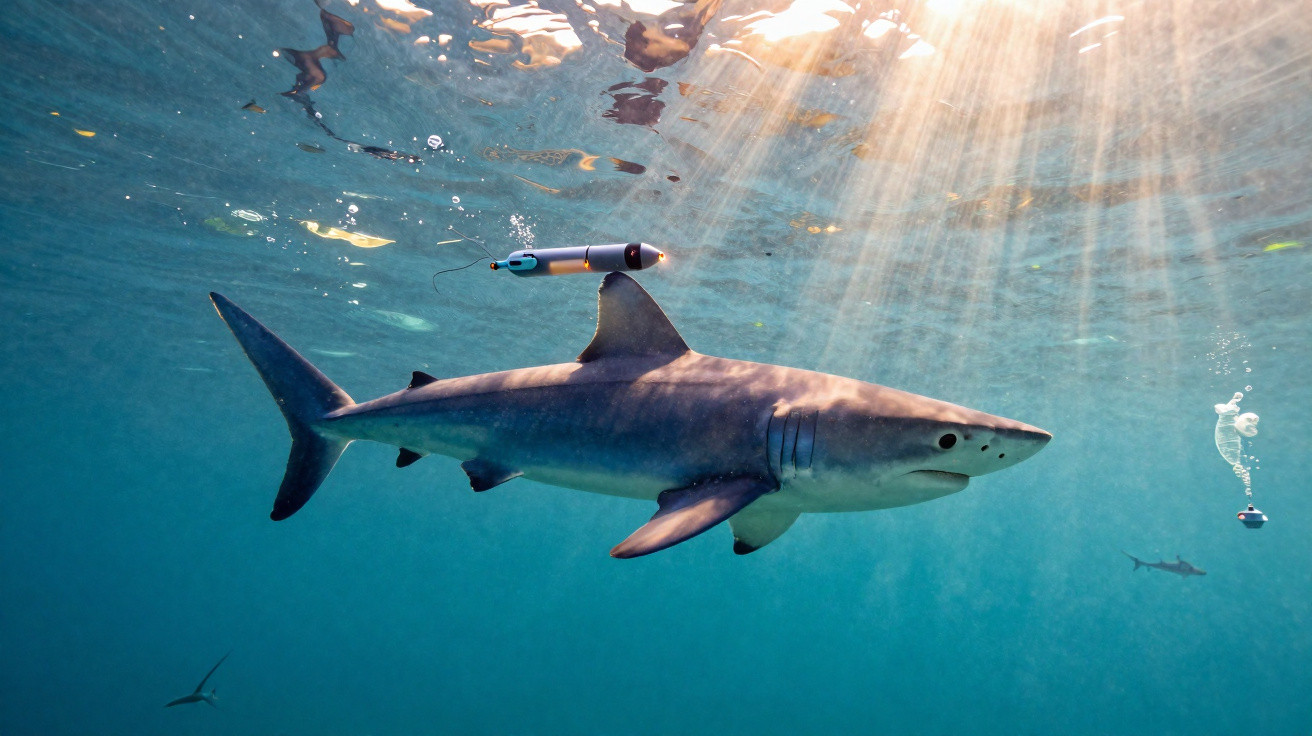
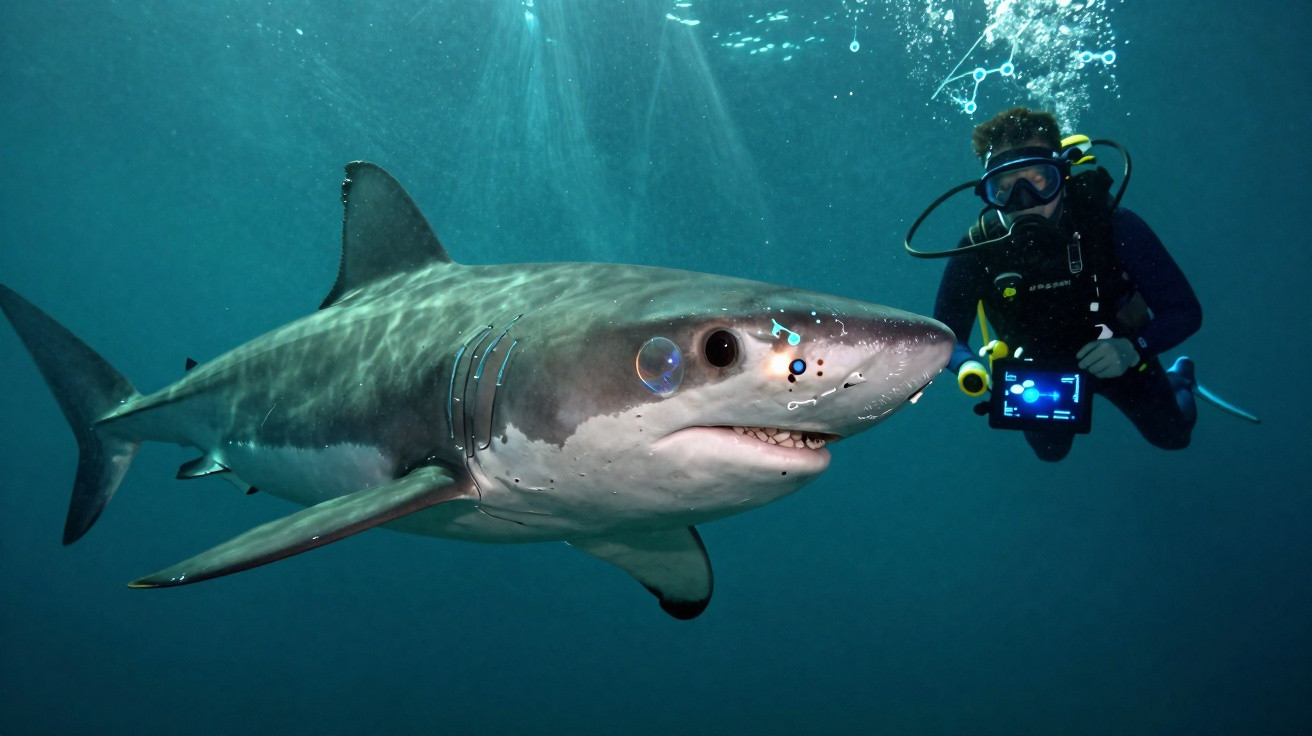
A new study points to an unlikely answer. Sharks already travel through these hard-to-observe areas, and they are helping researchers produce better ocean predictions.
Oceans are still difficult to monitor
Ocean observations underpin climate and weather models. To work effectively, these models require an accurate initial view of water temperatures and currents. If that starting picture is incomplete, forecasts can become less reliable.
Certain locations are particularly challenging to observe, including the Northwest Atlantic. The Gulf Stream changes position regularly, while eddies break away and travel in unpredictable directions.
The interaction between shallow coastal waters and deep-ocean areas adds further complexity.
Important regions have limited data
Satellites cannot observe beneath cloud cover, and Argo floats steer clear of turbulent waters. As a result, crucial parts of the ocean remain insufficiently measured.
“Sharks are already moving through parts of the ocean that are challenging for us to observe,” said Laura H. McDonnell, the study’s lead author and now a postdoctoral investigator at the Woods Hole Oceanographic Institution (WHOI).
“This research shows that data they collect can help fill important gaps and, when used carefully, can improve how we predict ocean conditions.”
Sharks can gather useful data
Researchers have previously used animals as ocean sensors. Elephant seals, grey seals and seabirds have all been fitted with instruments.
These animals head towards food, which tends to concentrate around ocean fronts and eddies – precisely the places where observations are often absent.
Sharks cover great distances and can dive to considerable depths. Blue sharks are capable of descending beyond 1,000 metres, whereas shortfin makos travel rapidly close to the surface.
They commonly follow the boundaries between warm and cold water masses. Understanding these transitions is important for tracking changes in the ocean.
Ben Kirtman is an atmospheric scientist at the University of Miami‘s Rosenstiel School and lead scientist of NOAA’s North American Multi-Model Ensemble system.
“Marine predators like sharks naturally seek out dynamic ocean features such as fronts and eddies,” said Kirtman. “These are areas where models often lack sufficient observations.”
Sharks measure temperature and depth
In 2021, researchers tagged 18 blue sharks and a single shortfin mako off the coast of Cape Cod.
Every shark was equipped with a compact satellite tag that recorded temperature and depth. When the animal surfaced, the sensor transmitted its information.
Collectively, the sharks delivered more than 8,200 profiles over time, including nearly 59,000 measurements. Several dives extended to almost 2,000 metres.
The recorded temperatures spanned cold deep-water conditions and warmer temperatures at the surface. The sharks travelled across a broad area of the Northwest Atlantic.
“Key to this study was repurposing a more advanced tag capable of transmitting location data along with temperature and depth information,” said Neil Hammerschlag, a co-author of the study and executive director of the Shark Research Foundation.
“This allowed us to link subsurface ocean conditions directly to specific locations with known accuracy.”
Shark data improves climate models
The team incorporated the shark observations into version 4 of the Community Climate System Model. They then produced two forecast sets: one using conventional information and another that also used the shark data.
Both forecasts covered six months, after which researchers compared them against satellite observations and ocean records.
The findings revealed a noticeable improvement. Temperature forecast errors in coastal and slope areas fell by as much as 40 percent.
In certain months, errors on the continental shelf dropped by more than one degree Celsius. A difference of that scale is significant for practical decision-making.
More accurate forecasts can benefit fisheries, shipping and coastal planning.
Climate data from shark sensors
The strongest improvements occurred in shelf and slope waters, where complex mixing, steep seabed features and changing currents interact.
Climate models find it difficult to represent these processes in detail. Adding even a limited amount of fresh information can therefore increase their accuracy.
Conditions are more even across the open ocean. Since models already perform more effectively there, the added shark observations produced smaller gains.
The benefits of shark data also persisted. Although the observations were introduced at the beginning of the forecasts, the improvements continued for months.
This indicates that the observations placed the model on a more accurate course from the outset.
Forecasts made later also showed greater stability. The model more accurately represented both average conditions and how those conditions changed over time.
Sharks provide distinctive coverage
Over the study period, sharks gathered roughly 90 percent more profiles within the study area than Argo floats.
Argo floats are still vital for ocean monitoring around the world. However, sharks reached locations that floats frequently fail to sample.
“Tagged sharks won’t replace conventional observing systems,” McDonnell noted.
“What the preliminary results do show is that tagged marine predators can provide complementary in-situ observations at the surface and at depth.”
The research provides a practical demonstration based on a small number of animals during one season.
Even so, the concept has considerable potential. Extensive animal-tracking datasets already exist, and networks are seeking ways to incorporate them into forecasting systems.
“Marine animals are already being tracked to understand their behavior in relation to environmental conditions, but this study reveals how these data can also be leveraged for forecasting and climate applications,” Hammerschlag said.
Improved protection for coastal life
Better forecasts can inform everyday choices. Fishers can map out routes, managers can safeguard resources and communities can prepare for changing conditions.
“For fisheries and coastal communities, small improvements in ocean forecasts can make a big difference,” said Camrin Braun, a WHOI oceanographer and co-author of the study.
“Reducing uncertainty helps people plan, whether that’s where to fish, how to manage resources, or how to respond to changing conditions.”
Sharks have always navigated the ocean precisely, following places where food accumulates and environmental conditions change.
Scientists are now using those natural journeys to enhance climate tools. With small tags attached, sharks become active participants in ocean science.
This method combines biology with technology in a practical manner, creating a new route towards understanding an ocean that is both complex and changing.











Comments
No comments yet. Be the first to comment!
Leave a Comment