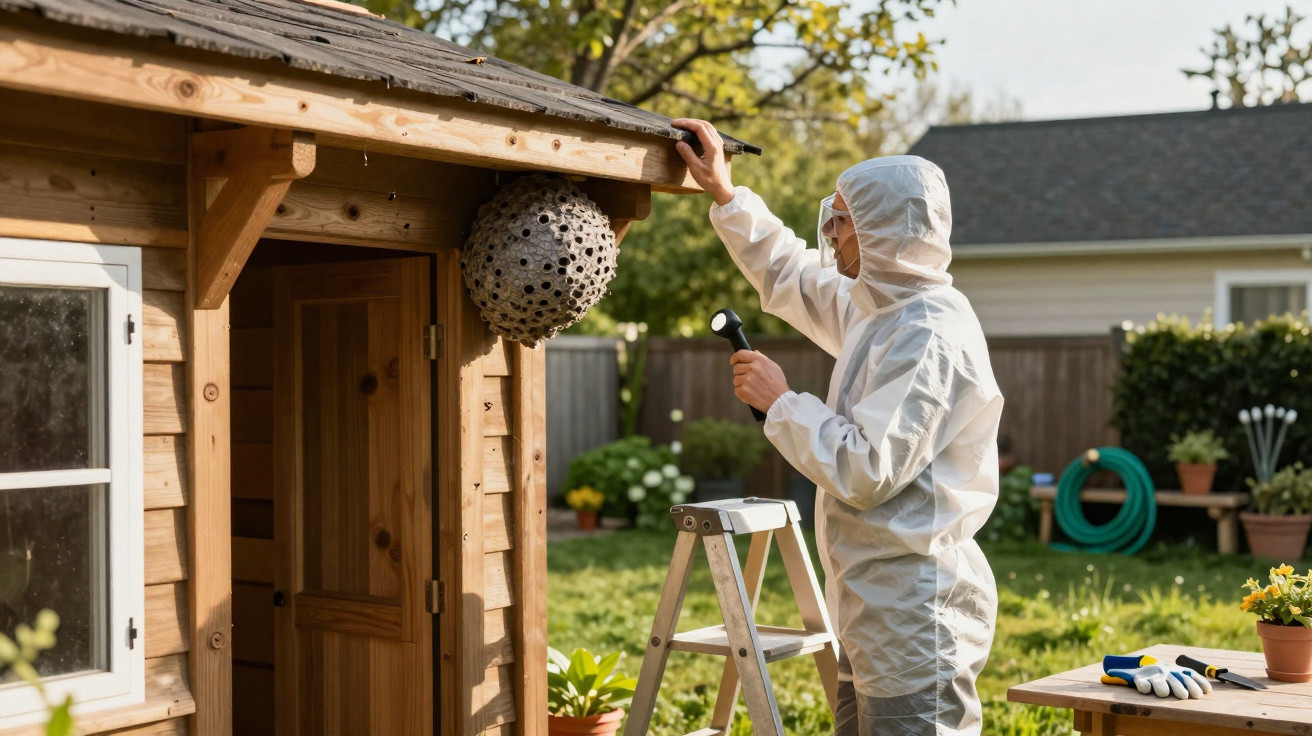
Between February and May, the Asian hornet often builds its first tiny nest unnoticed on homes and garden sheds. Knowing its usual hiding places and interpreting a few key signs can prevent a major summer infestation without putting yourself at risk.
An unseen springtime risk
As the first mild days arrive, overwintering Asian hornet queens emerge. They immediately begin looking for a suitable site, often choosing locations close to houses, garages and sheds. These places offer warmth, shelter from the wind and plenty of wood for nest-building material.
At this point, the queen creates what is known as a primary nest: a small grey ball made from paper-like material, initially barely bigger than a table-tennis ball. These miniature nests frequently go unnoticed for weeks because few people look up beneath the roofline or at the ceiling of a garden shed.
“Anyone who spots the tiny nest in spring can prevent a large colony of hundreds of hornets later on.”
If left undisturbed, the nest may develop into a much larger structure over the summer. Flight activity then increases, the insects become more unsettled, and approaching the nest in late summer and autumn can quickly become hazardous, particularly where there are vibrations or loud noises nearby.
Beneath the roof: where to look first for Asian hornets
The good news is that there is no need to climb onto the roof. An initial check can be carried out safely from the ground. Walk slowly around your home and pay particular attention to these areas:
- Roof overhangs and projections
- Cladding along the roof edge
- Boards on gable ends and eaves
- Gaps and small openings beneath the roofline
Focus on sides that receive the most sun, such as south- or west-facing walls. These areas are especially warm, which appeals to the queen. Looking for the nest itself matters, but the characteristic flight pattern is often the most useful clue.
How to identify an active nest
Where a primary nest is located beneath the roof edge, you may notice a repeated flight route: individual hornets repeatedly head to the same point and disappear there. This could be a tiny gap, a recess or a grey ball attached to the underside of the roof.
Look out for the following signs:
- One hornet repeatedly flying back and forth to a fixed point
- A faint buzzing or humming sound when the surroundings are very quiet
- A smooth grey ball measuring 3 to 5 centimetres across, with its opening facing downwards or sideways
The nest is usually attached to the underside of the roof overhang, close to the fascia board. It is protected from rain and wind there, while the wall also provides warmth. This combination makes the spot particularly attractive to the queen.
“Binoculars are a safer alternative to a ladder: staying several metres away protects you without reducing visibility.”
In the garden shed: a discreet favourite location
Garden sheds, tool stores and small timber summerhouses are also particularly popular. If they are rarely used during winter, their ceilings may receive no attention for months. For a queen, this provides ideal peace and quiet.
Common hiding places in a shed include:
- Ceiling areas where beams meet the roof
- The inner surface of roof sheets or corrugated panels
- Dark corners, for instance above shelves or tool hooks
Many people open their shed for the first time in spring, reach for a rake or lawnmower, and fail to see the small ball above their head. Only when the queen feels threatened may she attack.
How to inspect a shed safely
Proceed slowly and keep some distance. This straightforward approach helps to avoid stress for both people and insects:
- Open the door carefully, then wait briefly to see whether hornets are already entering or leaving.
- Use a torch to inspect the ceiling and corners deliberately, without standing beneath a possible nest site.
- Do not position yourself directly below suspicious areas; instead, remain diagonally to one side.
- Watch for individual hornets repeatedly flying towards the same location.
A nest that appears empty does not necessarily mean there is no danger. In cool weather, activity may stop completely for a while before resuming when temperatures rise. Check the location again at a different time of day before reaching a conclusion.
What to do if you find a nest
If you discover a nest, do not react impulsively. Keeping your distance is the most important step.
- Maintain a safety distance of several metres.
- Keep children and pets away from the area.
- Avoid noise and vibrations nearby, including mowing, drilling or hammering.
Take a photograph with your smartphone, ideally using zoom and without flash. This allows specialists to assess the species and location more accurately later. Do not use sticks, water jets, fire or shop-bought sprays: such attempts often go wrong and can result in painful stings.
“Never tackle it yourself: removing a hornet nest is a job for professionals.”
Next, report the find to the relevant local authority. In many areas, the council coordinates the response and can refer you to trained pest-control professionals or conservation services. Describe the location as precisely as possible, for example:
- On the underside of the roof on the south side of the house
- On the garden shed ceiling directly above the door
- On the roof overhang above the patio, close to the outdoor light
A response is generally arranged promptly, ideally while the nest is still at an early stage. In spring, it is still possible to prevent subsequent large-scale reproduction effectively.
Why the Asian hornet is so problematic
This species is considered invasive and has been spreading across Europe for years. A strong colony can catch enormous quantities of insects during summer, including many honey bees. This places pressure on beekeepers and further weakens pollinator populations that are already under strain.
For people, the main risk is being close to a nest. Individual hornets are often peaceful, but they can react aggressively when defending it. Multiple stings may be dangerous for people with allergies or heightened sensitivity. Pets such as dogs and cats can also quickly be at risk if they approach out of curiosity.
How to check your home and garden preventatively
Anyone who does not want to wait until the first hornets become noticeable can build a brief inspection routine into everyday life. Three to five minutes is often enough:
- During spring walks around the garden, regularly inspect roof edges and overhangs.
- Look inside seldom-used garden sheds and outbuildings several times each season.
- In warm weather, watch briefly to see whether hornets repeatedly fly in the same direction.
If you are unsure whether the insect really is an Asian hornet, send the photograph to local conservation organisations or specialist groups. They can usually identify the species quickly from its colouring and body shape.
Practical advice in an emergency
If you accidentally work near an active nest, remain calm. Sudden movements make the insects more agitated. Retreat slowly without swatting or waving your arms. If several hornets have already focused on you, distance is the only solution; if necessary, move several metres away until they leave you alone.
Stings are painful but do not cause serious consequences for most people. Cool the affected area immediately, for example with a damp cloth or cold pack, and monitor how you feel. If you experience breathing difficulties, dizziness or extensive swelling, call the emergency services straight away.
Knowing where this species prefers to build makes it possible to recognise critical situations much earlier. A quick look under the roof or at the shed ceiling in spring can determine whether a single queen later becomes a large, troublesome colony, or whether professionals remove the nest before it becomes genuinely dangerous.















Comments
No comments yet. Be the first to comment!
Leave a Comment