High in the tree canopies of the South American rainforest, a research team has encountered an insect that could upend every textbook on termites.
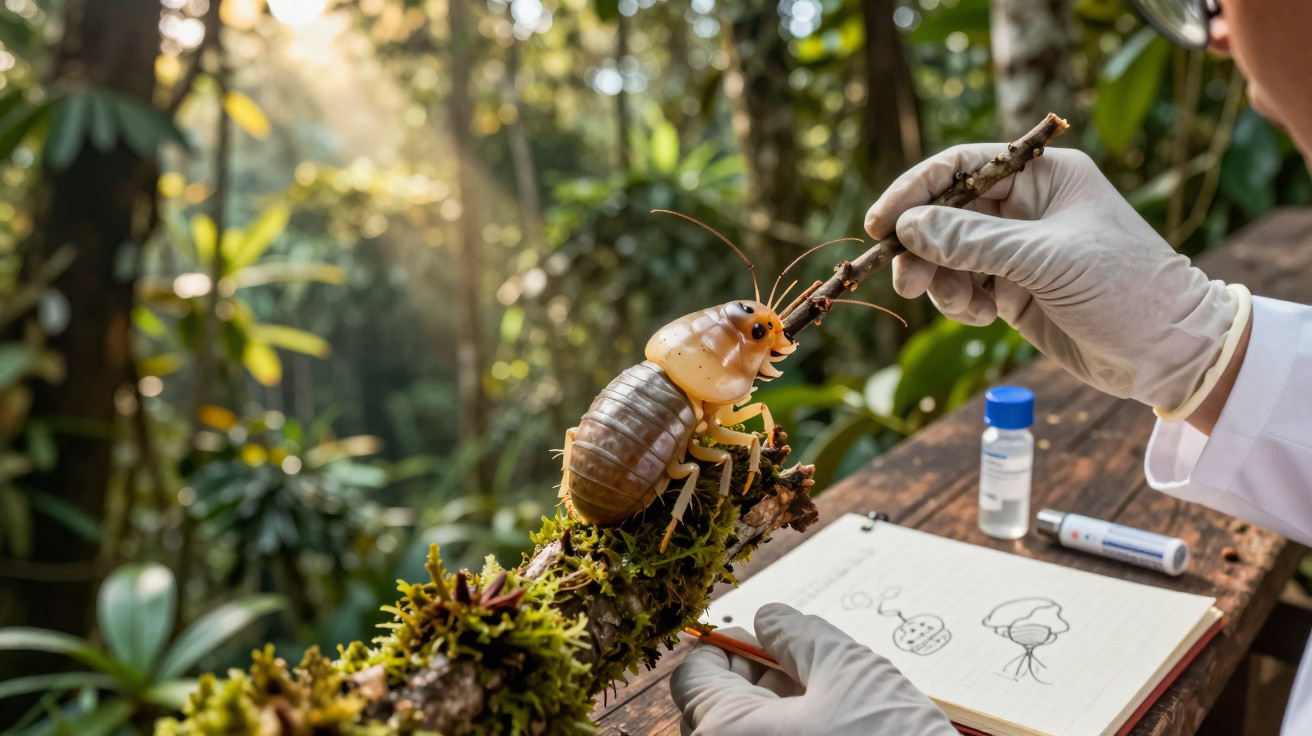
Inside a dead branch fork, several metres above the forest floor, lives a termite species that appears to have come straight from science fiction. These minute insects have a grotesquely enlarged head, more reminiscent of a whale than an insect – and researchers around the world are puzzling over the purpose of this extraordinary shape.
A miniature “whale”: what makes this termite so unusual
The discovery was made in the canopy of a rainforest region in French Guiana. There, biologists examined dead branches still suspended around eight metres above the ground. One such branch contained a small colony of the newly described species Cryptotermes mobydicki.
Even the first look through a binocular microscope made it clear that this was no ordinary termite anatomy. In particular, the so-called soldiers – the individuals responsible for defending the nest – look entirely unlike their relatives.
The soldiers’ head capsule is extended dramatically forwards, forming a swollen “snout” that strongly resembles the outline of a sperm whale.
This striking feature inspired the species name. The researchers deliberately referenced the famous whale character “Moby Dick”. The comparison is more than a playful laboratory joke: it accurately conveys just how radically the insect’s proportions have changed.
A head that conceals the jaws
Typical termite soldiers possess powerful, clearly visible jaws, which they use to bite enemies or block nest entrances. In Cryptotermes mobydicki, however, this equipment is almost entirely hidden from view.
- The insects are only a few millimetres long.
- Their heads account for a substantial proportion of their overall body length.
- The jaws are completely concealed beneath the elongated front section of the head.
- No other known termite species displays a comparable shape.
For taxonomy – the scientific classification of species – this is a major finding. Nothing similar has previously been recorded within the well-studied termite genus Cryptotermes. Around 3,000 termite species have been described worldwide, yet none has such an exaggerated head structure.
What this unusual anatomy might do
The research team described the new species in detail in the scientific journal ZooKeys, providing precise head measurements and comparisons with every known South American relative. Yet the key question remains unanswered: what exactly is this whale-like head for?
Several working hypotheses have been suggested:
- A living door lock: Many drywood termites use their heads as cork-like plugs to seal tunnels leading outside. The exceptionally elongated head may fit particularly effectively into narrow, tube-shaped passages.
- Protection from predators: The bulky shape may make it harder for ants or other enemies to grasp the head or force their way through the tunnel.
- A signalling or scent chamber: The enlarged head could contain glands that produce chemical substances for communication or deterrence.
Observations of living behaviour are still unavailable. The colony was collected in an isolated research area, and the insects occupied a single piece of dead wood. It may be years before a team using high-resolution cameras and specialist climbing equipment reaches another active nest.
A view into the canopy – the least understood part of the forest
The species was found at the Nouragues research station, deep within humid tropical forest. The site is remote and can be reached only by boat and helicopter. From there, canopy researchers use ropes, cranes or scaffolding to work at heights of up to 40 metres.
Most tropical species do not live on the ground but in the canopy – precisely the place researchers have studied least.
Dead branches that remain suspended in the trees form an ecosystem of their own. Fungi, beetle larvae, termites and other wood-feeding organisms bore through this material. Many are strictly tied to these specialised microhabitats and never appear in conventional ground traps or light traps.
The discovery of Cryptotermes mobydicki illustrates how incomplete knowledge of these habitats remains. New species continue to emerge even in comparatively well-studied regions, often with anatomical characteristics nobody would have anticipated.
Genetic analysis reveals an unexpected family history
Alongside the physical description, the researchers analysed genetic material from the new species. DNA shows how closely, or distantly, different populations are related. The result does not fit the idea of a purely local curiosity from one small patch of rainforest.
Cryptotermes mobydicki is closely related to termites from:
- Colombia
- Trinidad
- the Dominican Republic
The species apparently belongs to a broader lineage of drywood termites in tropical America. How these tiny creatures spread across such vast distances is still unclear. Several possible explanations are being discussed.
Termite colonies may have drifted on floating wood carried by ocean currents. Migratory birds that transport infested wood are also considered possible carriers. Historic climatic shifts, during which forests contracted or expanded, may have triggered additional movements as well.
No danger to homes – but essential to the forest
Anyone whose first thought on hearing “termites” is of damaged roof timbers can rest easy in this case. The new species and its relatives inhabit only dead wood in natural settings. Based on current knowledge, they show no interest in houses or furniture.
Their ecological role, by contrast, is central. Termites break down and digest wood that might otherwise remain in place for decades. Working alongside fungi and bacteria, they return nutrients to the natural cycle.
| Function | Importance in the rainforest |
|---|---|
| Wood decomposition | Dead branches are broken down, creating space for new growth. |
| Nutrient recycling | Nitrogen, phosphorus and other elements are returned to the soil. |
| Structure formation | Tunnels and cavities provide habitat for other small animals. |
Without this “rubbish collection service of the forest”, the canopy and forest floor would gradually become clogged with debris. The spectacular “whale head” may seem curious, but it belongs to a highly specialised cog in the rainforest system.
What the discovery says about the true number of rainforest species
The new species brings the known total of South American Cryptotermes species to 16. Researchers agree that this represents only a small part of the real picture. Many termite lineages remain hidden away – in inaccessible treetops, slender lianas and decaying palm fronds.
Modern rope-access techniques, drones and mobile canopy platforms are improving access to these areas. Each expedition produces dozens of new data records, often including photographs of animals that nobody can identify. Their form and genetics are then compared in the laboratory. Step by step, this produces family trees showing how species have diversified over millions of years.
This knowledge matters greatly for species conservation. To protect habitats, it is necessary to know at least broadly what lives within them. Specialised species such as Cryptotermes mobydicki, which depend on dead wood at a particular height, are likely to be highly sensitive to forest fires, logging or storm damage.
Termites – troublesome wood-eaters or underestimated key animals?
In Europe, termites are more commonly regarded as a nightmare for the construction industry. In the tropical rainforest, they occupy a very different position. They aerate the soil, alter the structure of wood and provide food for countless predators.
Researchers refer to them as “ecosystem engineers”: through their building activity and their appetite, termites actively reshape their surroundings. The bizarre head shape of Cryptotermes mobydicki is a reminder of how extensively evolution has already shaped these inconspicuous creatures – and how many of nature’s tricks are still waiting to be discovered.
Anyone walking through a South American rainforest in future and spotting dead branches in the canopy may look upwards differently: every apparently lifeless piece of wood could contain a colony whose anatomy may rewrite textbooks. The “whale termite” is probably only the beginning of a whole series of such revelations.










Comments
No comments yet. Be the first to comment!
Leave a Comment